“Markerless motion capture will make us better clinicians because it keeps us honest.” – Cassidy Papa
What You Will Learn
- How biomechanics and AI redefine rehab and performance in the NBA.
- Why technology matters only when it improves athlete communication.
- How longevity and performance share the same physiological roots.
Introduction
Every NBA season is a marathon disguised as a sprint. Between the 82-game grind, constant travel, and the unrelenting push for performance, the human body becomes both laboratory and battlefield. This episode of the Finding Small Wins podcast dives into that world through the lens of Cassidy Papa, physical therapist and performance specialist for the Charlotte Hornets.
Our conversation explored how biomechanics and AI are reshaping modern performance therapy and how clinicians can merge data with intuition to keep players healthy, durable, and evolving across seasons. Cassidy’s path from water-polo athlete to NBA clinician mirrors the evolution of the field itself: curiosity, iteration, and collaboration guiding every next step.
Guest Background: Cassidy Papa
Cassidy Papa, DPT, SCS, is a sports physical therapist for the Charlotte Hornets. A former Division-I water-polo athlete at Stanford University, she earned her Doctor of Physical Therapy from USC and completed both a Sports Residency and Division I Fellowship at Wake Forest University. Her background bridges biomechanics, technology, and on-court performance, translating research into real-world strategies for NBA athletes. Her approach reflects a generation of clinicians fluent in both human movement and sports science seeing data not as replacement for judgment but as its refinement.
Residency, Fellowship, and the Pursuit of Mastery
“I’m naturally curious. I wanted more structured learning before stepping into elite sport.” – Cassidy Papa
Cassidy’s career illustrates the mindset of mastery through curiosity first, comfort later. She described how completing both a sports residency and a Division I fellowship helped bridge the gap between classroom knowledge and professional sport.
That structured immersion gave her more than protocols; it refined her pattern recognition. She learned how to filter chaos into priorities, how to observe subtle asymmetries, and how to operate within high-stakes interdisciplinary teams. Her story echoes a principle I share often: early specialization matters less than early exposure to mentorship, feedback, and context.
In our field, competence grows not from volume of cases but from depth of reflection. Cassidy’s path of residency, fellowship, real-world clinic time represents the deliberate practice model applied to performance therapy.
Life in the NBA: The Reality Behind the Glamour
“You hear about the travel schedule, but until you live it, you don’t realize how much it takes out of you.” – Cassidy Papa
Working in the NBA is often romanticized as limitless resources and glamorous travel. The truth is grittier. Cassidy described days shaped by late night flights, improvised hotel-gym rehabs, and the relentless demand to make decisions with incomplete information.
Performance therapy in this setting becomes triage by intelligence: knowing which interventions will matter most when time, equipment, and recovery windows are short. Cassidy spoke about collaborating with strength coaches to identify the “20 percent that gives 80 percent of the results,”
Efficiency, not excess, defines excellence. In the NBA, you don’t win with more tools—you win with smarter prioritization.
Collaboration Over Control: Letting Go to Level Up
“I’ve learned to let go of the reins. I’m one piece of the puzzle, not the whole picture.” – Cassidy Papa
Cassidy’s reflection captures a universal lesson: elite environments demand ego control. She emphasized how collaboration of. true problem-solving across disciplines is the currency of success. With only minutes per athlete, she and her performance staff must decide which stimulus carries the greatest return: manual work, loading, recovery, or conversation.
The NBA has evolved from silos to systems thinking. Physical therapists, strength coaches, and sports scientists now co-author an athlete’s training plan. Cassidy’s approach mirrors my own 3P Framework:
- Principles—treat the person, not the part.
- Process—experiment safely, test-retest relentlessly.
- Plans—collaborate and adapt daily
In this ecosystem, communication replaces hierarchy. Trust becomes the technology that keeps everything running.
From Subjective Feel to Objective Data: The Rise of Biomechanics and AI
“I use isolated muscle testing to take my bias out of the equation.” – Cassidy Papa
Cassidy outlined how her staff integrates isokinetic testing, wearable sensors, and motion-capture data to complement subjective feedback. The goal isn’t data collection rather it’s data translation. She tracks how individual tissues respond to load and how those responses evolve across training cycles.
Biomechanics, once confined to labs, now lives courtside. Force plates, markerless motion capture, and velocity-based training devices feed into AI-assisted dashboards that flag fatigue, asymmetry, or compensatory patterns before injury emerges.
Yet Cassidy remains grounded: technology should serve people, not the reverse. AI’s role is pattern recognition and helps highlighting what humans might miss, but interpretation still belongs to clinicians. As she noted, the true skill lies in knowing when data is insight and when it’s noise.
Longevity as a Performance Metric
“Our goal is to keep them doing what they love for as long as possible.” – Cassidy Papa
Longevity used to mean career survival; now it’s a measurable output. Cassidy and I discussed how aerobic fitness, strength symmetry, and workload management intersect with orthopedic durability. The qualities that extend life expectancy are VO₂ max, muscle mass, relative strength are also extending playing careers.
She highlighted how chronic load “callusing” in the offseason and that building aerobic base and sprint exposure creates resilience for the grind ahead. That philosophy aligns perfectly with the 360 Performance Profile I’ve developed: the same benchmarks used for safe return-to-play become preseason readiness standards.
In short, the art of longevity is the science of repeatability is how often an athlete can perform near peak without breaking down.
Technology as Teacher: Biomechanics and the Future of AI in Rehab
“Markerless motion capture will make us better clinicians because it keeps us honest.” – Cassidy Papa
The conversation turned to what’s next. Cassidy sees promise in markerless motion capture systems integrated with AI. Unlike traditional labs requiring sensors and eight cameras, new systems can quantify movement with a single iPhone feed.
Imagine AI analyzing a jump landing in real time, detecting asymmetry, then generating individualized loading recommendations. In that future, technology won’t replace the therapist but it will enhance perception.
The integration of biomechanics and AI represents a feedback loop: objective data validates intuition; intuition guides better data use. When merged, they create a precision model for human performance and one that honors both biology and behavior.
Teaching, Leadership, and the Next Generation
“I’m refining how I teach and present and trying to help our profession grow as a whole.” – Cassidy Papa
Beyond the court, Cassidy’s work as an educator at the Elite Basketball Rehab Conference shows how the next generation of clinicians will blend science with storytelling. Her presentations on workload, aerobic fitness, and sprint exposure remind us that performance therapy is both art and arithmetic.
Her message mirrors a timeless principle: start small, stay consistent, and surround yourself with people who hold you accountable. In a field obsessed with innovation, her advice remains refreshingly human.
Conclusion
Biomechanics and AI may refine the science, but longevity is still built on fundamentals movement, strength, communication, and care. Cassidy Papa embodies that evolution: a clinician who pairs data with empathy, curiosity with clarity, and teamwork with trust.
- Prioritize efficiency. Identify the minimal effective dose of time, load, or stress that yields adaptation.
- Collaborate relentlessly. Performance thrives when egos shrink and dialogue expands.
- Quantify what matters. Use objective tools to check intuition, not replace it.
- Build aerobic capacity. Fitness is injury insurance and longevity’s best investment.
- Start small and stay consistent. Incremental change beats overwhelming overhauls.
Listen to the Full Episode Here
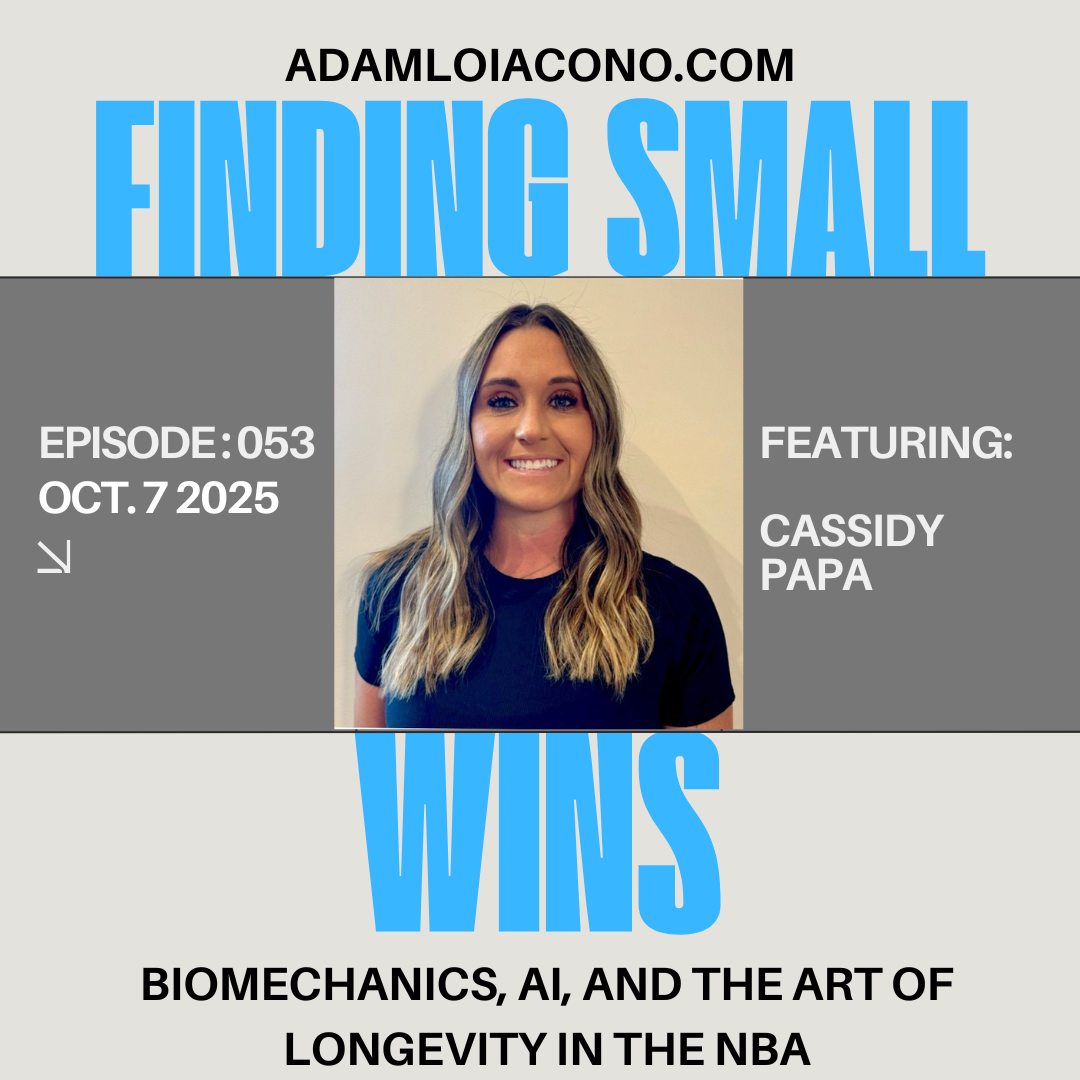
Episode Timeline
- 00:00 Origin story: California roots to the Charlotte Hornets
- 03:30 Lessons from water polo and transferable athletic skills
- 06:00 Residency vs Fellowship—deciding on advanced training
- 09:00 Life in the NBA: travel, load, and logistics
- 13:30 Collaboration and trust across disciplines
- 19:00 Prioritization and asterisk testing in rehab
- 23:30 Athlete feedback and subjective insight
- 30:00 Tech integration—data without overload
- 37:00 Biomechanics and markerless motion capture
- 40:00 Teaching and sharing through the Elite Basketball Rehab Conference
- 49:00 Advice for young clinicians and athletes
Read More Like This