Total distance doesn’t tell the load management story anymore, the game is defined by intensity, not mileage.” — Adam Parr
What You Will Learn
- Why traditional workload metrics like total distance are outdated
- The smarter GPS metrics shaping modern player monitoring
- How growth and maturation impact long-term development in youth athletes
Introduction
Load management has become one of the most overused (and misunderstood) phrases in sport. In soccer, the conversation often centers around “how much” a player ran, as if the game were a steady-state endurance test. But modern soccer isn’t linear, predictable, or slow. It’s a series of explosive accelerations, sharp decelerations, repeated changes of direction, and intermittent high-speed actions.
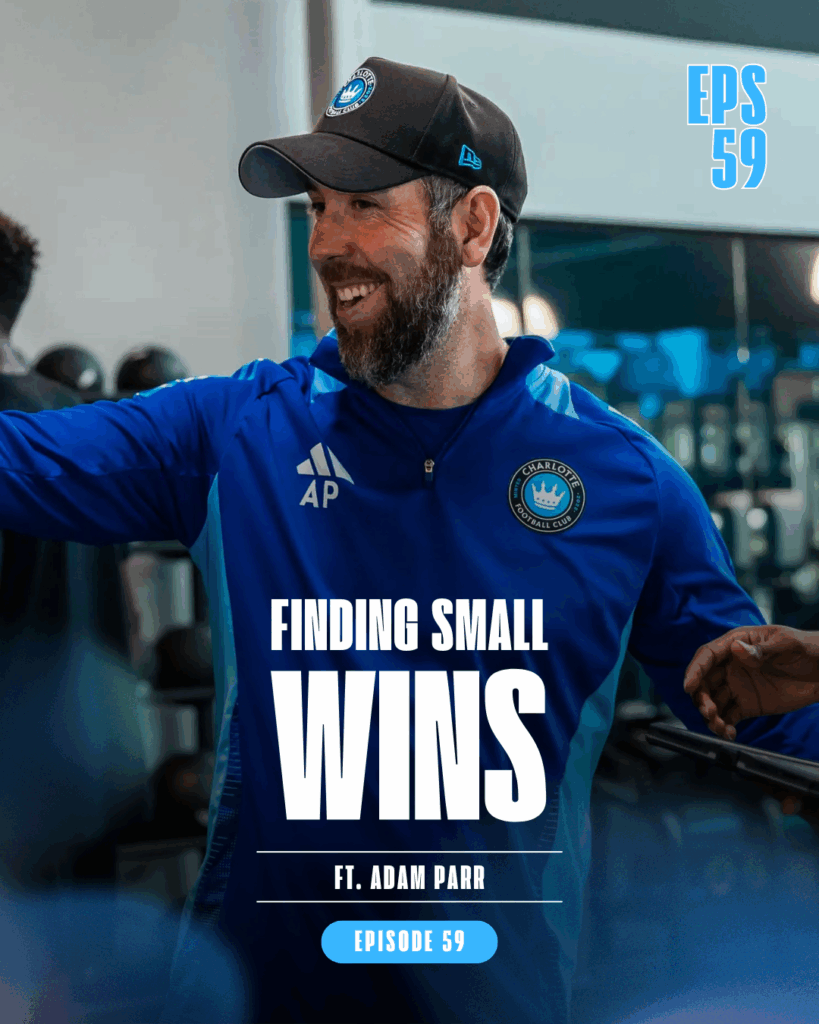
In this episode of the Finding Small Wins podcast, I sat down with Adam Parr, High Performance Science Lead in Major League Soccer, to unpack how the field has evolved and why the smartest teams have moved beyond the basics.
What Adam describes is the shift from volume-based thinking to intensity-based understanding. Instead of counting miles, practitioners are analyzing how players create, absorb, and tolerate mechanical stress, using data streams that mirror the true demands of the sport.
And crucially, the conversation extends beyond first teams. Adam’s work in MLS also includes youth development, and we break down how growth spurts, training age, and maturation influence everything from injury risk to gym progressions.
This episode is a blueprint for the future: smarter data, better development, and load management rooted in biology rather than buzzwords.
Guest Background:
Adam Parr’s path through professional soccer spans more than a decade, from early stints at Chivas USA to roles with Minnesota United, San Jose, and now Charlotte FC in MLS organization. He has lived every version of the performance department: strength coach, sports scientist, performance manager, and builder of youth-to-pro development pathways.
Adam represents a new wave of applied sports scientists, those who blend data literacy with coaching instincts, tactical understanding with physical profiling, and long-term athletic development with immediate system demands. He bridges the worlds of technology, coaching, and practical decision-making.
His expertise makes this conversation particularly valuable for practitioners, coaches, and athletes who want to understand what “modern” actually means in the performance space.
Why Total Distance No Longer Matters
“Total distance is fine if you want a summary, but not if you want to make decisions.”
For years, total distance was the headline number in soccer splashed across match reports and used as a shorthand for effort. But as Adam points out, total distance is driven by low-intensity movements.
A player can easily rack up mileage and look “fit” on paper. Yet that tells us nothing about:
- Their explosive capacity
- Their ability to absorb braking forces
- Their high-speed repeatability
- Their mechanical fatigue
- Or their risk profile
Smarter GPS Metrics: Acceleration Loads & Work-Rate Profiles
The modern game is built on moments, not miles. And those moments show up in the acceleration and deceleration data, the true stressors of the musculoskeletal system. Adam emphasizes three categories:
1. Acceleration Load
This reflects the total mechanical work a player performs when speeding up, slowing down, or changing direction.
Why it matters:
- It correlates more closely with muscle fatigue
- It predicts soreness and tissue stress
- It relates to tactical intensity
- It reflects actual match demands more than distance
2. Deceleration Counts
An overlooked load metric in soccer, decelerations produce very high eccentric forces, which:
- Tax tendons
- Challenge joint stability
- Influence readiness
- Predict soft-tissue strain risk
Adam notes that medium-intensity decels, not just the big ones, add up quickly across training and matches.
3. Work-Rate Metrics
Measured in meters per minute, work-rate provides a clean, instant indicator of training or match intensity. It answers one question: Is this drill exposing players to the speed and chaos of the game?
High-level practitioners use work-rate to:
- Benchmark training intensity
- Replicate tactical demands
- Prepare players for congested weeks
- Compare drills to match profiles
This moves load management from a volume conversation to a demand conversation, and it helps practitioners design training that prepares players for the real game.
Growth, Maturation & Peak Height Velocity (PHV)
Youth athletes are not miniature pros. Their physiology is shifting month to month, sometimes week to week. The most disruptive period? Peak Height Velocity, the rapid growth window that changes limb lengths, coordination, muscle force, and tissue tolerance. Adam outlines how PHV impacts development:
- Strength drops temporarily as limbs lengthen
- Sprint mechanics shift
- Injury risk increases
- Movement quality becomes inconsistent
- Load must be adjusted, not simply reduced, but redirected
The goal isn’t to protect players from stress, but to shape it intelligently. Adam describes the developmental model as:
- Ages 14–15 → Foundations
- Ages 16–18 → Strength & power education
- Second team → Advanced progressions
- First team → Individualized prescription
Applied Sports Science: Where Data Meets Coaching
“Good sports science lives between the laptop and the training pitch.”
One of the biggest misconceptions Adam addresses is the idea that sports science is only about numbers, dashboards, and devices. Applied sports scientists must:
- Communicate clearly with coaches
- Translate data into decisions
- Understand tactical context
- Recognize individual variability
- Integrate weight room, field, and recovery information
Tech is not the answer, it’s the assistant. The answer is always a human conversation, supported by evidence and context.
The Future: Player-Centered, Intensity-Driven, Development-Aligned
Our conversation ends with a clear picture of where performance is heading:
- From volume → to intensity
- From generic models → to individualized development
- From tech usage → to tech understanding
- From monitoring → to decision-making
- From mileage → to meaningful actions
Load management is no longer a buzzword. It’s the process of matching biological capacity to football demand.
Conclusion: The Small Win
The small win from this episode is recognizing that load management is not about limiting players rather it’s about understanding them. The shift from total distance to smarter metrics gives practitioners a clearer lens into:
- How athletes work
- How they fatigue
- How they adapt
- And how they stay healthy
And when youth development, maturation, and applied coaching are layered into that lens, performance science becomes more than data. It becomes a pathway to building better footballers. Here are 5 key takeaways from the conversation:
- Blend data with coaching instincts — sports science is only useful when applied collaboratively.
- Stop overvaluing total distance — intensity drives performance, not volume.
- Elevate acceleration and deceleration data — they reflect real mechanical stress.
- Use work-rate (m/min) to benchmark training intensity and drill quality.
- Track peak height velocity to adjust loads during adolescent growth windows.
Listen to the Full Episode Here
Episode Timeline
- 00:00 – 02:00 — Welcome, playoff-week context, and setting the table for performance science in pro soccer
- 02:00 – 08:00 — Adam Parr’s origin story: kinesiology, EXOS internship, early sport-science exposure
- 08:00 – 12:00 — First MLS experiences at Chivas USA and early heart-rate monitoring systems
- 12:00 – 18:00 — How the perception of sports science changed as technology evolved in MLS
- 18:00 – 23:00 — Designing a high-performance gym: intentional layout, equipment choices, and training flow
- 23:00 – 29:00 — Creating a unified development pathway: foundational → strength → power → advanced progressions
- 29:00 – 33:00 — Training age, development age, and why youth athletes must be progressed differently
- 33:00 – 37:00 — Peak Height Velocity: tracking growth, maturation, and modifying load during rapid growth phases
- 37:00 – 42:00 — Why total distance is outdated and how smarter GPS metrics paint a clearer picture
- 42:00 – 47:00 — Acceleration loads, deceleration counts, and work-rate intensity as superior indicators
- 47:00 – 51:00 — How high-level teams leverage data to predict readiness and prioritize specific stressors
- 51:00 – 55:00 — Misunderstandings about sports science: it’s not coding, dashboards, or tech—it’s applied decision-making
- 55:00 – 59:00 — League-wide challenges: travel burdens, fixture congestion, and their impact on injuries
- 59:00 – 01:02:00 — Final reflections: the evolution of sports science and the role of the PSPA in shaping the profession
- 01:02:00 – End — Closing thoughts and upcoming PSPA event in Atlanta
Read More Like This