Approximate Read Time: 15 minutes
“Constraints and injuries create clarity: when you can’t train everything, you finally learn what matters most and how staying fit through injury is a balancing act of physiology, timing, and constraints.”
What You Will Learn
- Use block-periodized conditioning to sustain strength and endurance during injury recovery.
- Coordinate energy systems to slow detraining and preserve athletic performance.
- Transform rehab into performance training through strategic load and modality selection.
The Hidden Challenge: Healing the Tissue Without Losing the System
Rehab isn’t simply a return-to-play process; it’s a management problem. While tissue healing follows biology, performance decays on a clock controlled by exposure to stressors. In elite athletes, this gap between structural recovery and systemic regression defines the difference of end stage rehab and return to play.
Within the first week of inactivity, measurable declines appear across the body’s major energy systems. VO₂ max drops 5–10 % per week and mitochondrial enzyme activity can fall 25–45 % (Mujika & Padilla, 2000). Strength is more resilient but not immortal: after four weeks of unloading, neural drive begins to wane, and cross-sectional area follows. If gone unchecked, what starts as a local injury can quickly becomes a global conditioning issue.
The antidote is deliberate, data-driven fitness maintenance — a system that respects both tissue constraint and physiological decay. That’s where two critical frameworks intersect:
- Energy-system coordination during rehab
- Residual Training Effects (RTEs)
Together, they provide a blueprint for staying fit through constraint and knowing what to train, when, and how often before adaptation fades.
The Science of Fitness Decay
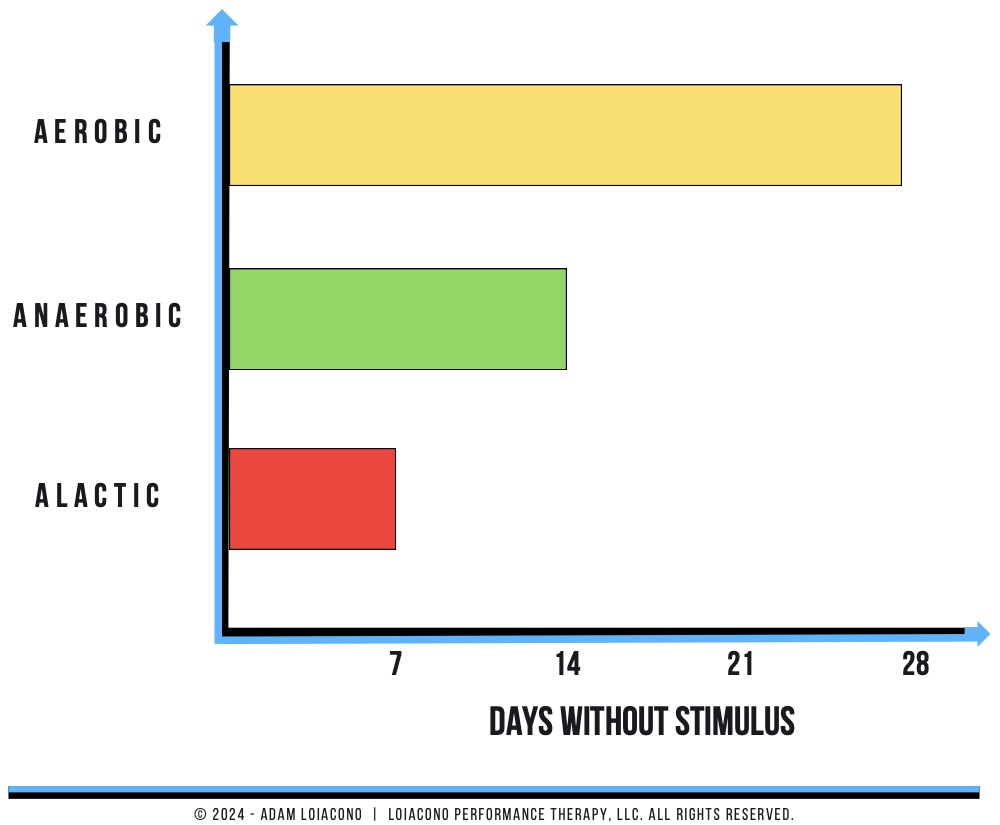
Every performance variable from aerobic endurance, anaerobic tolerance, and alactic power carries a different half-life. Issurin highlighted this in his work on Block Periodization and he labled this as Residual Training Effects. These are the time windows during which adaptations persist once direct loading ceases.
- Aerobic endurance: 30 ± 5 days
- Anaerobic glycolysis: 18 ± 4 days
- Maximal strength: 30 ± 5 days
- Speed & alactic power: 5 ± 3 days (Issurin, 2016)
Understanding these residuals transforms rehab from guesswork into precision conditioning. If an athlete’s aerobic base lasts ~30 days without stimulus, then a single zone-2 or zone-3 aerobic session every 7 days can maintain it.
If alactic speed decays in under a week, short maximal-effort exposures every 4–5 days become essential even if performed via alternative modalities like arm ergometry or pool sprints.
Why Residual Training Effects Matter in Rehab
Traditional rehab focuses on tissue tolerance. Block-periodized rehab focuses on system tolerance over time. Each adaptation of strength, aerobic capacity, or neuromuscular speed has a “residual,” a fading echo that persists after stimulus.
The goal is to time new stimuli before that echo disappears.
Issurin (2016) described this as superposition by stacking consecutive blocks so that residual effects overlap rather than vanish. When applied to rehab, the logic is identical: while one system heals, others are strategically re-stimulated to prevent total deconditioning.
Think of it like maintaining multiple bank accounts:
- Your aerobic account holds value longest but needs periodic deposits.
- Your anaerobic account depletes faster and requires smaller, frequent deposits.
- Your alactic account is speed and explosiveness that empties almost immediately if left untouched.
By aligning conditioning sessions with these biological timelines, you respect both tissue recovery and energetic reality are the central paradox of staying fit during rehab.
FREE DOWNLOAD
Start Optimizing Your Stem Cell Recovery Today with this Recovery Guide!
From Detraining to Design
Once we understand when adaptations fade, the next question becomes how often to retrain them. Here is a simple timeline for each energy system:
- Alactic exposure every 4–5 days
- Aerobic loading once per 7-14 days
- Anaerobic loading every 7–10 days
This schedule is not arbitrary; it mirrors Issurin’s residual-effect durations (Issurin 2016). Aerobic capacity holds for roughly 30 days, anaerobic glycolysis ≈ 18 days, and alactic speed only 5 days. By cycling stimuli at these frequencies, we “top-up” each system before decay occurs.
Practically, this means that a lower-extremity-injured athlete might perform:
- Day 1: Arm-ergometer HIIT (anaerobic block)
- Day 4: Deep-water sprints (alactic exposure)
- Day 7: Long, steady cycling (aerobic block)
Rehab calendars built this way resemble miniature block-periodized programs: each micro-cycle emphasizes one system while maintaining the others through residual carry-over.

Vector Thinking: Matching Modality to Constraint
Every injury constrains movement along certain vectors linear, lateral, and vertical , which correspond to running, cutting, and jumping actions. Understanding these vectors is essential for choosing safe conditioning options. For instance:
| Injury Region | Primary Constraint (Early Rehab) | Movement Vector Restored in Late Rehab | Conditioning Emphasis |
|---|---|---|---|
| Foot/Ankle | Limited load tolerance | Vertical → Multidirectional → Impact | Bike → Sled push/pull → Jump rope |
| Knee/Thigh | Load & volume restriction | Linear → Vertical | Bike → Incline walk → Aerobic plyos |
| Hip/Low Back | Hip flexion or impact limitation | Multidirectional → Rotational | Pool → Sled work → Plyos |
| Shoulder/Elbow | Upper-extremity usage | Core & rotational vectors | Bike → Ski erg → Medicine-ball circuits |
This matrix reframes rehab as a movement-vector problem, not a body-part problem.
Once the primary vector is identified, conditioning simply shifts stress toward available vectors while respecting healing tissue.
The Zone Model: Prescribing Intensity With Precision
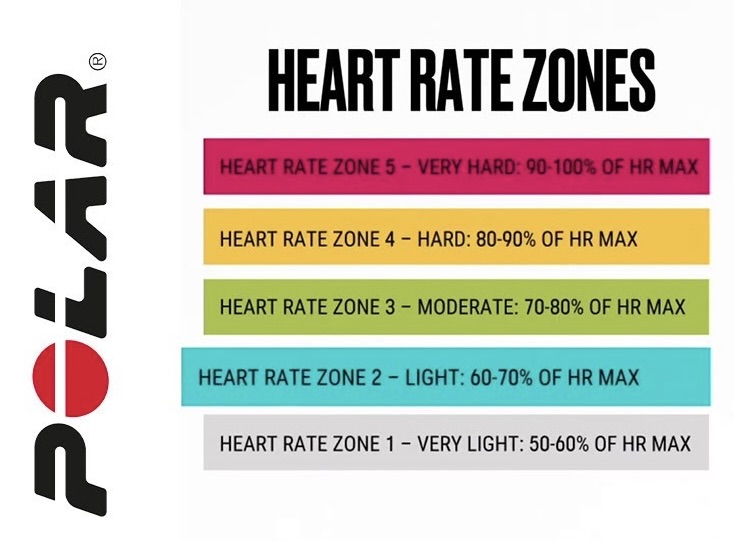
For most athletes in early rehab, Zones 1–3 (recuperation → aerobic maintenance → aerobic development) dominate the first month
- Zone 1 (< 60 % HRmax): circulatory flush, BFR circuits, walking or light bike
- Zone 2 (60–69 %): aerobic maintenance via sled drags or bike intervals
- Zone 3 (70–79 %): aerobic development, 4–15 reps of 30 s–6 min efforts, RPE 8/10
As pain and tolerance improve, the plan progresses toward Zones 4–6 (anaerobic development → capacity), reintroducing incomplete recoveries and higher mechanical output. Each heart-rate zone becomes a controllable variable with volume and intensity calibrated not by guesswork but by physiological intent.
Acute Lower-Extremity Injury
Lower-extremity injuries like ankle sprains, ACL reconstructions, hamstring strains are the most common performance disruptors because they restrict locomotion, which is the cornerstone of both aerobic and alactic loading. Yet, these injuries also present the clearest opportunity to test whether we really understand adaptation: when one system goes offline, can the rest of the system keep training?
Step 1 | Define the Constraint
| Region | Early-Stage Constraint | Vector Lost | Primary Focus for Conditioning |
|---|---|---|---|
| Foot/Ankle | Load intolerance / instability | Vertical + multidirectional | Maintain aerobic capacity → contralateral cycling, ski erg |
| Knee | Load volume and impact restriction | Linear → vertical | Preserve anaerobic power → pool running, BFR cycling |
| Hamstring/Thigh | Deceleration and eccentric tolerance | Linear → transverse | Maintain alactic speed → arm erg, core rotation |
| Hip/Low Back | Flexion and rotational stress | Multidirectional | Maintain aerobic engine → sled drags, high-seat bike |
The vector lens gives context: we’re not training the “good leg,” we’re sustaining the available vectors while tissue repair occurs in the restricted one.
Step 2 | Choose the Energy System to Protect
Using Issurin’s residual-effect durations:
| Energy System | Residual Effect | Frequency in Rehab | Example Modalities (Lower Injury) |
|---|---|---|---|
| Alactic Power | ~5 days | Every 4–5 days | 10-s max arm-erg sprints × 8; sled pushes with harness |
| Anaerobic Capacity | ~18 days | 1–2 × per week | 60–90 s intervals on arm erg or deep-water runs |
| Aerobic Endurance | ~30 days | 1 × every 7 days (minimum) | 30-60 min zone 2 bike or pool session |
| Max Strength | ~30 days | 2 × per week | Contralateral BFR isometrics, core anti-rotation press |
This schedule ensures that each system is still being stressed while we allow adequate recovery for the injured tissue.
Step 3 | Build the Weekly Micro-Cycle
A practical example for a right-ankle grade II sprain (non-weight-bearing first 10 days):
| Day | Session Focus | Zone / System | Modality & Prescription |
|---|---|---|---|
| Mon | Aerobic maintenance | Zone 2 (60-69 % HRₘₐₓ) | Arm erg × 30 min continuous (steady cadence) + breath work 5 min |
| Wed | Anaerobic power | Zone 4 (80-89 %) | Ski erg 6 × 90 s / 90 s easy RPE 9 / 10 |
| Fri | Alactic capacity | N/A | 10-s max arm-erg × 8 @ 1:8 work:rest |
| Sun | Recovery / Perfusion | Zone 1 (< 60 %) | Pool mobility circuit + BFR bike |
Despite no ground contact, this program maintains aerobic and anaerobic systems and stimulates type II fibers through BFR, which can be a direct counter to the atrophy spiral that normally follows immobilization.
Step 4 | Progress Along the Continuum
When partial weight bearing is permitted, we can start to layer in conditioning principles within the rehab prescription:
- Re-introduce vertical vectors through sled push/pull and incline walking.
- Layer in aerobic plyometrics (jump rope, hops in pool) to rebuild elasticity.
- Progress heart-rate zones from 2→3→4 while monitoring swelling and RPE.
By Week 5, the athlete should tolerate short bouts of eccentric load.
Issurin’s accumulation → transmutation → realization sequence fits perfectly:
- Accumulation (Weeks 1-2): aerobic & strength maintenance
- Transmutation 1 (Weeks 3-4): anaerobic power and vector exposure
- Transmutation 2 (Week 5): alactic speed return
- Realization (Week 6+): gradual return to running & COD drills
Each block overlaps through residuals, so as one ability rises and another doesn’t collapse. This offers a practical solution for multi-targeted block periodization inside rehab (Issurin 2016).
Common Errors and Corrections
| Mistake | Why It Matters | Correction |
|---|---|---|
| Waiting for “healing” before conditioning | Accelerates systemic decay and lengthens return timeline | Start non-invasive conditioning within 72 h if medically cleared |
| Over-loading uninjured limb | Creates asymmetry and secondary overuse | Use BFR bilaterally and alternate vector demands |
| Ignoring heart-rate zones | Leads to energy-system misalignment | Anchor intensity to zone model |
| Neglecting alactic work | Loss of speed and power within 7 days | Add max-effort sprints on safe modality every 5 days |
| No objective testing | Blind progressions increase risk | Track HR, force output, RPE, and ROM weekly |
Integrate Into Team Workflow
For team environments, conditioning for injured players should mirror the team’s periodization. If the squad is in a high-intensity block, the athlete should maintain a similar workload via cross-training. This preserves rhythm and readiness while keeping them synchronized with the team’s collective cycle.
Remember, if you measure it then you manage it.
- Measure workload wtih session RPE × duration
- Monitor heart rate with appropriate tech (i.e. heart rate straps)
- Keep total weekly stress within ±10 % of pre-injury load.
Acute Upper-Extremity Injury
Upper-extremity injuries like rotator-cuff tears, labral repairs, UCL sprains, and post-op shoulder reconstructions can be deceptively complex. Unlike lower-body injuries that limit locomotion, these often allow movement but restrict force transfer and spinal loading. The challenge isn’t aerobic decay, but it’s how to continue high-intensity work without provoking the shoulder or elbow.
Step 1 | Define the Constraint
Upper-extremity injuries primarily restrict vertical pressing, rotation, and grip-based load. Early in rehab, this limits training that involves trunk rotation or closed-chain weight-bearing (push-ups, crawling, overhead lifts).
| Region | Early-Stage Constraint | Movement Vector Lost | Conditioning Focus |
|---|---|---|---|
| Shoulder | Load intolerance, overhead rotation | Vertical / rotational | Aerobic + lower-body power |
| Elbow | Gripping and pushing | Linear → rotational | Maintain aerobic / anaerobic capacity |
| Wrist/Hand | Gripping, contact tolerance | All pushing vectors | Maintain aerobic base via lower body |
Step 2 | Train What’s Left — Not What’s Lost
Issurin’s residual-training-effect timeline becomes crucial. Since maximal strength and aerobic endurance persist ≈30 days (Issurin 2016), these systems should be periodically “topped-up” through lower-body and core work.
Example: Shoulder surgery (0–6 weeks post-op)
| System | Residual Window | Frequency | Safe Modality | Goal |
|---|---|---|---|---|
| Aerobic | ~30 days | 2 × wk | Stationary bike / treadmill walk | Maintain cardiac output |
| Anaerobic | ~18 days | 1 × wk | Sled drag / lower-body circuits | Preserve glycolytic capacity |
| Alactic | ~5 days | 1 × wk | Short bike sprints × 10 s @ RPE 10 | Retain neuromuscular speed |
| Max Strength | ~30 days | 2 × wk | Leg press, hip thrusts, BFR legs | Retain systemic strength |
Even during immobilization, the athlete can train systemic qualities. Research on cross-education demonstrates that unilateral resistance training of the healthy limb can preserve up to 80 % of strength in the immobilized one through neural drive and cortical spillover (Mujika & Padilla, 2000).
Step 3 | Vector Progression
Once clearance allows elbow-to-torso motion, conditioning expands into rotational and vertical vectors via low-impact tools:
- Medicine-ball toss circuits: rotational patterning without elevation stress.
- Ski erg intervals: re-introduce symmetrical pushing at controlled ROM.
- Pool running + sled pulls: integrate core-to-hip linkage.
Step 4 | Return-to-Sport Power Integration
Late stage rehab and return to plays emphasize alactic and skill-specific exposure.
- 5 × 15 s sled sprints or Assault Bike bursts @ 1:6 work-rest
- Contralateral arm plyometrics: medicine-ball throws, unilateral presses.
- Closed-chain holds: quadruped holds, pull-up holds
Chronic / Systemic Injuries: Managing the Long Game
Chronic conditions like tendinopathy, post-surgical stiffness, autoimmune inflammation, or systemic fatigue expose the need for long-arc programming. The goal shifts from “return” to “maintenance through cycles.”
The Continuum of Chronicity
In these athletes, residual effects blur. Instead of sharp training peaks, we manage fluctuating readiness:
- Aerobic base acts as a buffer against inflammation and symptoms.
- Isometric and slow-tempo resistance maintain muscle endurance without overload.
- Periodic regenerative blocks like stem-cell therapy, exosome injections, or recovery micro-cycles can replace deloads.
Example | Chronic Patellar Tendinopathy
| Block (2 weeks) | Primary Target | Secondary Maintenance | Methods |
|---|---|---|---|
| Block 1 – | Aerobic capacity | Isometric pain modulation | 30 min bike @ 70 % HRmax + 5×45 s isometrics |
| Block 2 – | Strength endurance | Movement variability | HSR 3×8 @ 70–80 % 1RM + BFR exercise |
| Block 3 – | Plyometric re-introduction | Energy storage | Sub-max hops, depth drops (3×6) |
The Human Element + The Psychology
Every athlete ties identity to performance. Removing competition sometimes creates an identity crisis. By offering opportunities to train when they cannot play, this can often fill the void of athlete identity. It is not a perfect 1-to-1, yet it keeps the body busy rooted in sound principles.
Putting It All Together
- Start with Constraints → Identify Vectors. (What can move?)
- Map Residuals → Schedule Frequency. (When will it decay?)
- Block Plan → Sequence Stimuli. (Which system first?)
- Monitor → Adjust. (What changed?)
- Repeat.
When these steps synchronize, rehab becomes performance training under constraints. Instead of re-starting from zero, the athlete returns already fit, neurologically sharp, and psychologically engaged.
Conclusion: The Art and Science of Staying Fit During Rehab
Staying fit during rehab is not luck; it’s logistics married to physiology.
By combining Issurin’s residual-effect timelines, the vector-based modality logic of Conditioning for Rehab, and your own 3P Framework, we replace the myth of rest-equals-recovery with a blueprint for sustained adaptation.
Injury limits structure, not potential. With clear principles, measured processes, and intelligent plans, every setback becomes an opportunity to refine both the athlete and the system that supports them.
Five Key Takeaways
- Residual Awareness: Each energy system decays on a predictable timeline; schedule conditioning before decay, not after.
- Vector Thinking: Injuries remove movement directions, not fitness potential; train the vectors that remain.
- Block Logic: Use short, sequenced blocks (2–4 weeks) to develop one quality while maintaining others.
- 3P Integration: Principles guide decisions, Process manages adaptation, Plans provide structure.
- Mindset Matters: Rehab is not waiting rather it’s building capacity through constraint.
FREE DOWNLOAD
Start Optimizing Your Stem Cell Recovery Today with this Recovery Guide!
Watch More Like This
Read More Like This
Related Podcasts

References
- Mujika I, Padilla S. Detraining: Loss of Training-Induced Physiological and Performance Adaptations. Sports Med.2000;30(2):79-94.
- Lisman PJ et al. A Systematic Review of the Association Between Physical Fitness and Musculoskeletal Injury Risk. J Strength Cond Res. 2017;31(6):1744-1757.
- Issurin VB. Benefits and Limitations of Block Periodized Training Approaches to Athletes’ Preparation. Sports Med. 2016;46(3):329-338.
- Hughes L et al. Blood Flow Restriction Training in Clinical Musculoskeletal Rehabilitation: A Systematic Review and Meta-Analysis. Br J Sports Med. 2017;51(13):1003-1011.
- Beyer R et al. Heavy Slow Resistance Versus Eccentric Training as Treatment for Achilles Tendinopathy. Am J Sports Med. 2015;43(7):1704-1711.