Read: 8 minutes
Watch: 10 minutes
Write: 0 minutes
Therapy Phase — “Fix the Parts”
The Therapy phase is where we “fix the parts,” but in reality, we fix the parts without losing sight of the system they belong to. This is simple part-task learning, but executed through a systems lens: the scapula lives on the rib cage, the humerus lives on the scapula, and the rib cage lives under the influence of the pelvis, spine, and respiratory mechanics.
Our job in the Therapy phase is to restore local capacity—rotator cuff strength, scapular mechanics, rib mobility—while preventing the athlete from drifting into compensation patterns. The goal isn’t perfection. The goal is helping the shoulder regain enough capacity (≈70%) to transition to the Training phase, where whole-task, integrated motion takes over.
FOCUS OF THE THERAPY PHASE
Local Capacity & Part-Task Restoration
This phase is where I isolate the impaired component—rotator cuff force, scapular posterior tilt, rib IR/ER asymmetry—and restore its function in controlled, predictable contexts.
At this stage:
- The system must be organized for success, not chaos
- Movements must be slow, stable, and precise
- The athlete needs clear sensory feedback
- The rib cage must be “shape-able,” allowing the scapula to sit and move correctly
- The rotator cuff must progressively reclaim its ability to center the humeral head
This is not strengthening in the traditional sense. This is restoring architecture.
RELEVANT TESTING IN THIS PHASE
Testing anchors this phase to criteria, not guesswork:
ER:IR Ratio (Neutral to 45° ABD)
- Reflects internal rotator dominance vs posterior cuff capacity
- Guides early loading and isometric choices
Isometric Peak Force at Multiple Angles
- 0° → 45° → 90° abduction
- Measures how scapular mechanics, rib cage shape, and cuff activation change with arm elevation
ASH Test (T-position at Reduced Lever Length)
- Long-lever force transfer in a safe, controlled variation
- Identifies early scapular stability and posterior tilt capabilities
These tests highlight the true bottleneck of the system—whether it’s the cuff, scapula, rib cage, or trunk.
SYSTEMS THINKING RATIONALE
Restore Scapular Posterior Tilt Capacity
Posterior tilt is not a “scapular exercise problem.”
It is a rib shape → scapula-on-rib → cuff recruitment problem.
When the upper ribs are compressed (rectus dominance), the scapula is forced into anterior tilt. Restoring rib expansion gives the scapula permission to tilt back.
Improve Rib Internal/External Rotation Asymmetries
Rib IR/ER dictates the scapular resting position.
Improved rib mechanics = better cuff leverage.
This makes rib mobility and breathing strategies a primary intervention—not accessory work.
Build Tissue Capacity Without Introducing Chaos
This phase avoids high-speed or unpredictable loading.
We load:
- Slowly
- Deliberately
- With precision
- With stable bases of support
This builds internal joint confidence before we expose the shoulder to whole-task demands.
| Identified Problem | Systems Interpretation | Practical Intervention |
|---|---|---|
| Scapula stuck in anterior tilt | Upper ribs compressed (RA dominance) → pump-handle restricted → scapula forced forward | Manual: Upper rib pump-handle mobilization, pec minor decompression Closed Chain: Quadruped thorax flexion/expansion drills Open Chain: ER isos with rib expansion cues |
| Weak ER or low ER:IR ratio | Posterior cuff under-recruited; rib IR deficits; thorax rotates poorly on fixed scapula | Manual: Posterior rib expansion, scapular posterior tilt guidance Closed Chain: Tripod holds with breath into back ribs Open Chain: 0° → 45° → 90° ER isometrics |
| Poor upward rotation | Serratus not anchoring; ribs can’t ER laterally (bucket-handle restriction) | Manual: Lateral rib expansion, EO inhibition breathing Closed Chain: Forearm wall slide + lift-off Open Chain: Prone Y, 135° plane isometrics |
| Short-lever ASH T-position weakness | Thorax unstable under horizontal force; scapular retraction delayed | Manual: Posterior rib ER mobilization Closed Chain: Bear holds with posterior expansion Open Chain: Short-lever T raises → band T isometrics |
| ROM loss (flex/abd) | Rib shape restricts scapular rotation; poor posterior expansion | Manual: Thoracic ring stacking, pump/bucket mechanics Closed Chain: Wall-assisted reaches with breath Open Chain: Serratus + cuff coactivation during elevation |
PRACTICAL MANUAL THERAPY SUGGESTIONS
Manual therapy must support the system, not override it.
Upper Rib Pump-Handle Mobilization
Goal: Reduce rectus dominance → restore upper rib expansion
Application:
- Supine, hands under upper ribs
- Guide inhalation into pump-handle expansion
- Gentle mobilization on exhale to encourage rib drop
Lateral Rib Bucket-Handle Mobilization
Goal: Improve EO length/tension balance → restore side expansion
Application:
- Side-lying, therapist hand contacts lateral ribs
- Encourage inhalation into the lateral thorax
- Mobilize stiff segments to restore bucket-handle motion
Posterior Expansion Techniques
Goal: Posterior mediastinum expansion
Application:
- Quadruped or standing
- Therapist cues breath “into the back”
- Hands guide ribs into ER/IR with breath cycles
Scapular Posterior Tilt Facilitation
Goal: Reintroduce scapular motion atop a changing rib cage
Application:
- Therapist supports scapula from inferior angle
- Guides posterior tilt as the athlete exhales
- Builds neuromuscular awareness for later phases
Soft-Tissue Work: Pec Minor, Lat, Upper Trap
Use sparingly. The real work is restoring rib mechanics, but soft-tissue input can reduce perceived stiffness so the system reorganizes more easily.
CLOSED-CHAIN EXERCISE PROGRESSION
Closed-chain work is foundational in this phase because it:
- Anchors the scapula
- Allows the thorax to move on the scapula
- Improves serratus recruitment
- Integrates rib mechanics with shoulder control
Quadruped Shoulder Flexion
Why: reduces gravity and encourages better scapula integration when open chain shoulder flexion is painful
Quadruped Scapular Control
Why: Scapula fixed → thorax moves → serratus turns on
Variations:
- Weight shift forward/back
- Contralateral reach
- Quadruped “sternum drops” (controlled thorax motion)
Tripod Progressions
Why: Introduces load, decreases stability demands
Variations:
- One-hand tripod rocking
- One-leg tripod core training

Bear Position Holds & Crawls
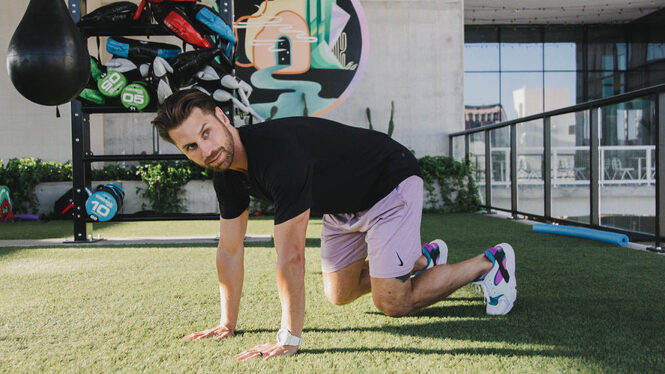
Why: Rib cage organizes under load; serratus-driven stability
Variations:
- Bear shoulder taps
- Bear breathing (posterior expansion)
Closed-chain is where the rib cage begins to reorganize in context.
| System Goal | Closed-Chain Progression | Open-Chain Progression | Key Cues to Maintain System Alignment |
|---|---|---|---|
| Restore posterior tilt | Quadruped rocking with exhale | Standing ER with posterior tilt | “Exhale ribs back; tilt scapula away from ribs.” |
| Improve rib IR/ER symmetry | Sidelying rib breathing + reach | ½ kneeling rotation with light ER | “Rotate ribs, not just the arm.” |
| Rebuild posterior cuff capacity | Tripod weight shifts | ER isos (0° → 45° → 90°) | “Keep ribs wide in the back.” |
| Anchor serratus + stabilize thorax | Bear holds → bear shoulder taps | Scapular punch → punch with rotation | “Push the floor away; float the ribs.” |
| Enhance upward rotation | Wall slide + lift-off | Prone Y + 135° elevation isos | “Grow tall through the ribs, not the low back.” |
| Improve horizontal force transfer | Quadruped T-reach | Short-lever ASH T-position → band T-hold | “Let the thorax move under the scapula.” |
OPEN-CHAIN EXERCISE PROGRESSION
Open-chain begins once scapular mechanics and rib mobility are stable.
Cuff-Specific Isometrics (0° → 45° → 90°)
Why: Progressively challenges scapular upward rotation
Variations:
- ER isometrics with thorax “stacking”
- IR isos with rib ER focus
Incline Y/T
T-position work but in short levers:
- T-raises
- Prone horizontal abduction
- Light ASH T-position holds
Why: Encourages peri-scapular muscles
Cue: keep arm long as you pull back
Standing ER/IR with Scapular Posterior Tilt
Why: Adds gravity and postural strategies
Cue: “Tilt scapula back as you exhale and rotate.”
Trunk Rotation with Shoulder AB/ADD
Why: Ensures integration of shoulder movement with lumbo-pelvic control
Variations:
- Cable diagonals
- Low-angle Y raises
Early Long-Lever Control
Open-chain = building controlled strength with evolving rib mechanics.
BREATHING & RIBCAGE TRAINING
RA Down-Regulation → Upper Rib Expansion
Drills:
- Supine 90/90 breathing
- Foam roller under thoracic spine
- “Eyes up, sternum soft”
Lower Lumbar Decompression -> Posterior Rib Expansion
Drills:
- Wall supported forward bend
- Quadruped
Posterior Expansion
Drills:
- Quadruped rotations
- Seated “hug yourself” breath
- Bear-position spreading breath
Breathing restores the rib cage → which restores scapular motion → which restores cuff mechanics.
HOW THE THERAPY PHASE SETS UP THE TRAINING PHASE
We only progress when the athlete achieves:
- ~70% capacity in ER/IR PF
- Improved rib IR/ER symmetry
- Clear scapular posterior tilt and upward rotation
- ASH T-position stability at reduced lever lengths
- Pain-free part-task loading in open and closed chain
- Consistent breathing mechanics that influence rib shape
The final output of Therapy is a shoulder that can be integrated, not isolated.
The Training phase will then take these restored “parts” and reassemble them into whole-task mechanics.
Fab Five
- The Therapy phase restores the “parts” but always through the lens of the whole system—scapular mechanics, rib rotation, thorax mobility, and breathing patterns dictate how the shoulder can load, tilt, and center during isolated exercises.
- Testing guides targeted interventions, using ER:IR ratios, isometric peak force at multiple angles, and early ASH T-position variations to identify where the cuff, scapula, or rib cage is limiting local capacity.
- Manual therapy supports rib and scapular mechanics, not just soft tissue comfort—pump-handle, bucket-handle, posterior rib expansion work, and scapular posterior tilt facilitation drive the biomechanical prerequisites for healthy cuff function.
- Closed-chain exercises rebuild thorax-on-scapula control, enhancing serratus recruitment, rib expansion, scapular stability, and foundational force transfer before progressing into open-chain demands.
- Open-chain loading reintroduces cuff capacity safely, progressing from isometrics in 0° → 45° → 90° abduction to short-lever T variations while maintaining rib control, breathing mechanics, and scapular orientation to set up successful whole-task training.