Read: 7
Write: 0
Watch: 10
When I build shoulder rehab programs—whether for a high-level thrower, a weekend pickleballer, or a post-op patient—my guiding principle is simple: progress the task, the load, and the degrees of freedom in a controlled, intentional way. The shoulder thrives on variability, but we must progress it intelligently.
Below, I’ll walk you through how I use that progression to guide clinical decisions.

A Reminder on Center of Pressure

Whenever I teach upper-extremity loading—pressing, weight bearing, carries, or even gripping a kettlebell—I come back to one foundational idea you’ve already learned in this mentorship: Sensory input drives motor output.
If the sensory map at the hand is poor, the motor strategy at the shoulder will be poor.
When an athlete places their hand on the ground, or wraps their fingers around a kettlebell or barbell, they’re not just “holding” an object—they’re creating a center of pressure (CoP). That pressure determines how the wrist loads, which dictates how the elbow organizes, and ultimately how the shoulder stabilizes.
Hand Pressure Determines Wrist Mechanics
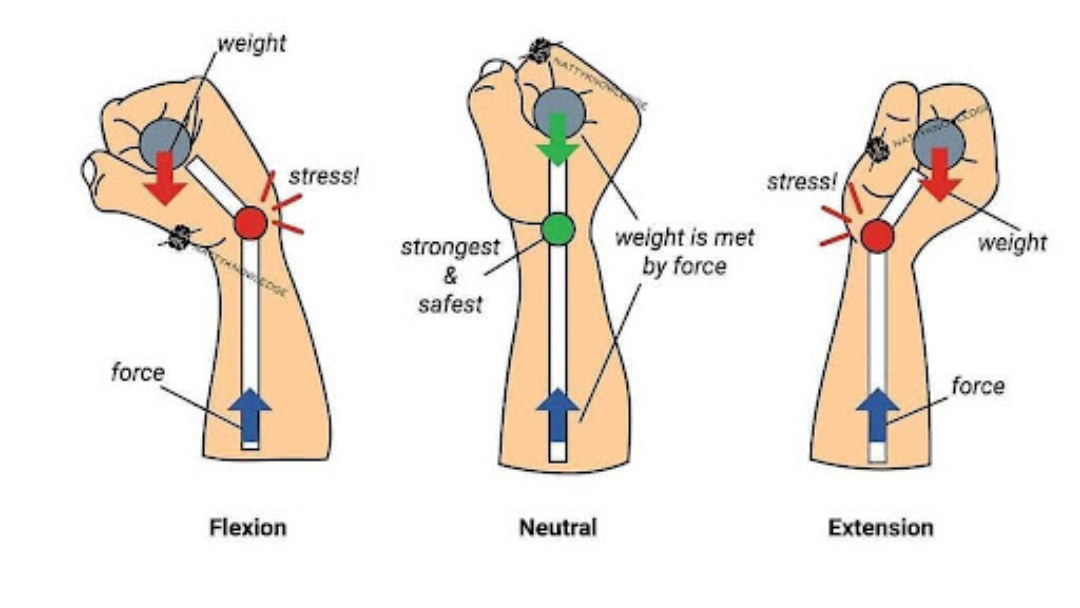
If pressure collapses toward the ulnar border, the wrist falls into extension and deviation. If pressure shifts toward the fingertips, the wrist stiffens and loses its ability to transmit force.
If pressure is distributed evenly through the heel of the palm and the first two knuckles, the wrist remains neutral—and neutral is where the forearm musculature can co-contract efficiently.
Wrist Mechanics Direct Elbow Orientation
A collapsed wrist shifts load to the medial elbow, changes the orientation of the elbow, and alters the line of pull of the triceps and biceps.
A centered wrist (driven by proper hand CoP) promotes a stacked forearm, which decreases shear and increases joint congruency at the elbow.
Elbow Orientation Organizes the Shoulder
This is the big one. The shoulder reads the position of the elbow as a proxy for where it needs to stabilize. If the wrist collapses → elbow flares or caves → shoulder compensates with excessive IR or ER, anterior tilt, or loss of cuff engagement.
If the wrist and elbow are stacked → the cuff can do its job: centrate the humeral head.
Another critical point to consider is antebrachial fossa position during exercise. Just like how a patella may orient laterally or feet may spin out during squatting, the same can occur with the elbow. The elbow and knee are simply iterations of one another. Elbows flaring out or going into valgus are going to impact muscle activity above and below.
The “Orthotic” in the Hand Changes the Strategy
The shape of the object dramatically influences where pressure lands.
- Barbell: Encourages linear force through the palm; poor hand placement leads to wrist hyperextension and anterior shoulder collapse.
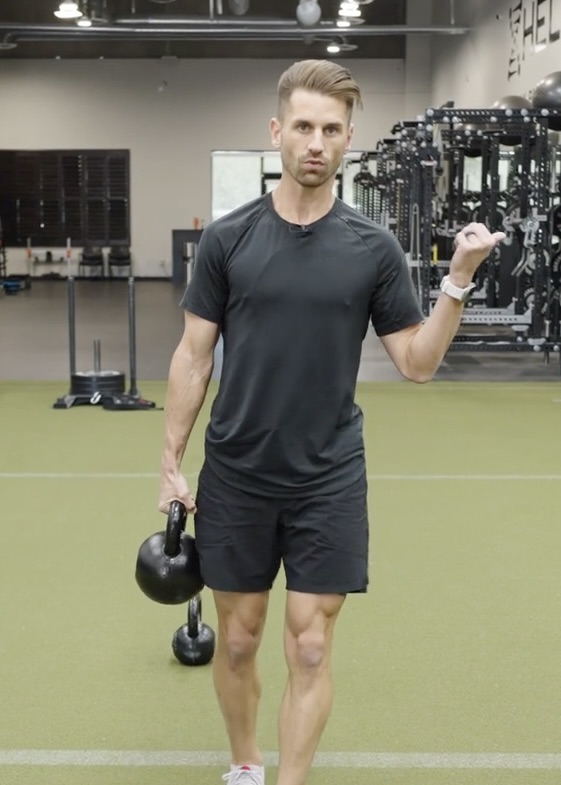
- Kettlebell: The offset mass forces the athlete to “find” the center of pressure; a poorly organized wrist immediately shows up as shaking or shoulder shrugging.
- Dumbbell: Neutral grip allows a more natural stacking, but athletes still need deliberate cues to maintain palm pressure and tripod contact.
This is why I don’t treat pressing variations as purely strength work—they’re sensory-motor assessments.
Start With Degrees of Freedom, Not Load
Early in shoulder rehab, the priority is restoring rotator cuff isometrics and positional awareness. This is why we start in supine 90-90:
- Gravity is minimized.
- The scapula is supported.
- The rib cage can be better controlled.
- The athlete can feel co-contraction without being overwhelmed.
Phase 1: Supine 90-90 Open Chain Isometrics
Why I use it: It reintroduces cuff tension without shear. Perfect for acute pain or early rehab.

Add Perturbation and Reactive Control
Once an athlete can hold position and maintain pressure into the ground/core, we challenge the cuff’s ability to respond to unpredictable input.
Phase 2: Supine 90-90 Rhythmic Stabilizations
Why it matters:
The cuff is never performing slow, predictable contractions during sport. It’s reacting—millisecond to millisecond—against massive torques.
Phase 3: Supine 90-90 + KB Screwdrivers
What this does:
It blends isometric co-contraction with rotational demand. Screwdrivers drive rotator cuff activation through the entire 90–90 arc.

Change the Base — Lift the Trunk
Now we start integrating rib cage mechanics, scapular control, and cuff activation into a single pattern.
Phase 4: Trunk Lift + KB Screwdrivers
As soon as I lift an athlete’s trunk, the degrees of freedom explode:
- The scapula must posteriorly tilt.
- The trunk must resist extension.
- The cuff must stabilize without table support.
This is where a lot of athletes expose their deficits.
Introduce Gravity Dominance
After positional and reactive control, it’s time to let gravity do its job. This is where carry variations outperform traditional banded ER in my experience.
Phase 5: KB Suitcase Carry
Now the cuff is asked to stabilize the humeral head while:
- The rib cage rotates
- The pelvis shifts
- The ground reaction force transfers up the chain
This is “real life” cuff control.
Phase 6: KB Front Carry
Front loading shifts the center of mass forward → the athlete must combat spinal extension and scapular anterior tilt tendencies.
This is an excellent drill for athletes with AC joint irritation or anterior shoulder sensitivity (when programmed appropriately).


Progress to High-Intensity, Multi-Planar Control
Phase 7: KB Half Get-Ups
Here, the cuff is working through:
- Hip-to-trunk sequencing
- Thoracic rotation
- Changing bases of support
- Loaded transitional patterns
This is where I see a huge jump in shoulder capacity and athlete confidence.

Phase 8: Full Get-Ups
This is the apex of shoulder rehab before return-to-sport preparation. The cuff works continuously for 20–40 seconds through dozens of micro-adjustments.
If an athlete can own a heavy get-up without pain, they’re usually ready to begin throwing or other intense shoulder activities.
How I Use This Progression in Real Rehab Cases
For Throwers:
I stay in the early phases longer—90-90 work is gold. They already have extreme ranges; they need control, not mobility.
For AC Joint Cases:
I limit early front-loaded patterns and aggressively restore scapular upward rotation before progressing into Phases 5–8.
For Instability Patients:
I treat this progression as mandatory, not optional. You cannot shortcut Phases 1–3.
For Post-Op Rotator Cuff Repair:
I use this as an end-stage framework after tendon integrity is restored. Screwdrivers and carries become key milestones for return-to-throw.
Fab Five
- The shoulder rehab progression should move from low degrees of freedom (supine 90-90 isometrics) toward higher degrees of freedom and load (carries and get-ups), matching the cuff’s real functional demands.
- Early phases emphasize joint centration, positional control, and reactive stability, building the foundation before adding gravity-dominated challenges.
- Mid-phase work integrates scapular mechanics, rib-cage control, and trunk alignment, ensuring the rotator cuff isn’t working in isolation.
- High-level phases (carries, half get-ups, full get-ups) restore multi-planar control, endurance, and kinetic-chain integration, which directly translate to throwing, hitting, and sport-specific demands.
- Proper progression depends on respecting degrees of freedom > load, meaning you regress by simplifying the environment—not just reducing weight—to maintain quality and shoulder integrity.