Why Throwing Rehab is Different
Before any protocol makes sense, you need to understand the mechanical reality of throwing. This isn’t a shoulder problem, rather it’s a full-body event that terminates at the shoulder with extreme speed and force. The research on throwing biomechanics (Trasolini et al., 2022; Dias et al., 2023) makes this unmistakably clear.
Approximately 54% of the total energy in a thrown baseball is generated from the lower extremity and trunk and transferred sequentially through the kinetic chain (Trasolini et al., 2022). When that chain is disrupted by injury, deconditioning, or guarding, the shoulder compensates, absorbing load it was never designed to manage alone.
This is why you cannot return a thrower to sport by only rehabbing the shoulder. () explicitly states:
“There is more to it than just external rotation/internal rotation strengthening.” – Wilk et al., 2016
During the arm acceleration phase, the shoulder internally rotates at speeds exceeding 7,000–9,000 degrees per second, which is the fastest recorded human body motion (Dias et al., 2023; Trasolini et al., 2022). During deceleration, the posterior rotator cuff must eccentrically absorb forces approaching 1x body weight. These are the tissue demands your return to play plan must build tolerance toward.
- Posterior rotator cuff (infraspinatus, teres minor): eccentric deceleration load
- Anterior capsule & subscapularis: late cocking stability
- Biceps tendon long head: SLAP lesion risk at ball release
- Periscapular stabilizers: maintaining platform under dynamic load
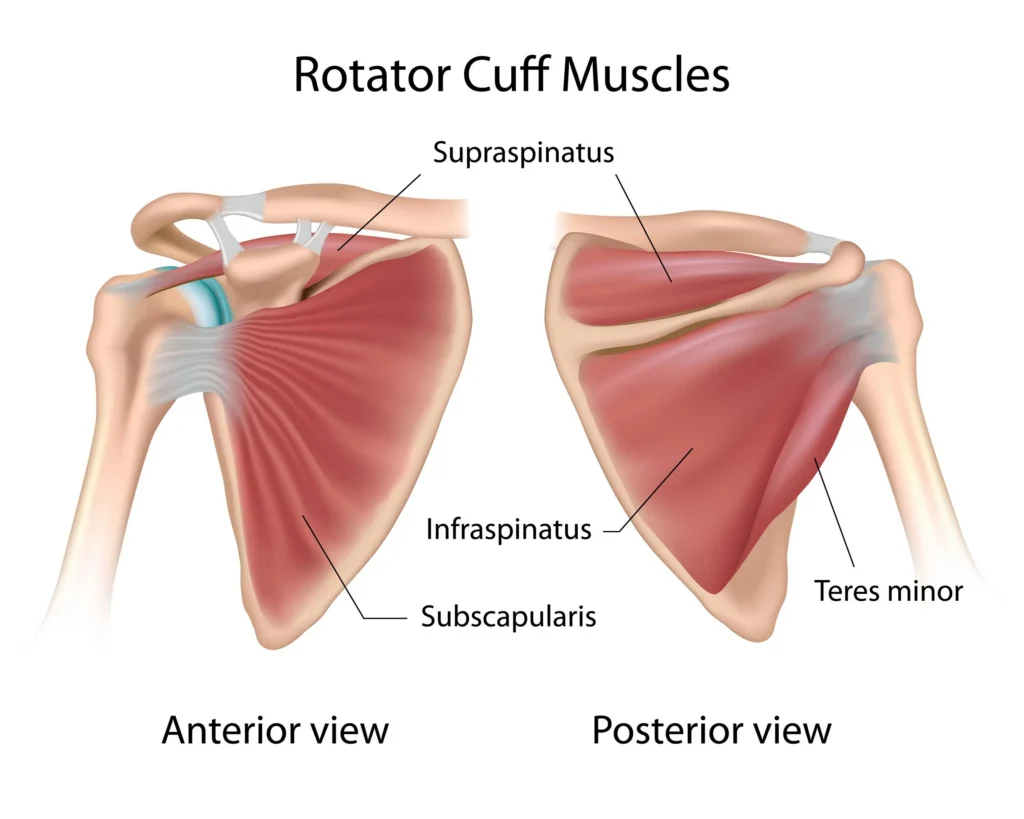
The central clinical question is: has tissue tolerance been restored to match sport demand? This requires progressive mechanical loading with throwing and not just static strength testing. Tissue adapts to the stresses placed upon it (Wolff’s Law / SAID Principle). The throwing program is the mechanism by which that adaptation occurs. As (Reinold et al., 2024) demonstrated, throwing programs built from biomechanical workload data produce safer tissue stress ramp-ups than older expert-opinion models precisely because they respect this principle.
Brief Insights from a Literature Review
The evidence base for return to throwing is substantial. A comprehensive review of 50 top-ranked research papers spanning 1989 – 2025 (Sgroi & Zajac, 2018; Wilk et al., 2024; Reinold et al., 2024; Dias et al., 2023) converges on several clear principles. Every therapist or coach working with throwing athletes should understand the strength of these findings and where the evidence still has gaps.
| WHAT THE RESEARCH TELLS US |
| Strong evidence (9/10): Criteria-based interval throwing programs outperform time-based protocols for safe return to sport. (Sgroi & Zajac, 2018; Reinold et al., 2024; Wilk et al., 2016) |
| Strong evidence (8/10): Objective readiness testing identifies athletes who appear ready by time but are not — up to 25% fail initial clearance. (Sgroi et al., 2022; Kurz et al., 2023; Wilson et al., 2020) |
| Moderate evidence (7/10): Updated ITPs using workload data (ACWR monitoring) reduce re-injury risk vs. older expert-opinion models. (Reinold et al., 2024; Dias et al., 2023) |
| Consistent finding: While >80% of athletes return to sport, fewer return to pre-injury performance level — especially post-surgically. (Sgroi & Zajac, 2018; Gouveia et al., 2023) |
| Known gap: No universally accepted objective cutoffs exist. Many protocols still rely on expert opinion. (Hermanns et al., 2021) |
Pre-Throwing Clearance: Objective Criteria Backed By Research
Skipping this clearance is the most common clinical error in return to throwing. Symptom-free at rest is not sufficient. Research found that up to 25% of athletes who appear ready by time-based criteria fail objective readiness testing, but can pass after targeted therapy addressing identified deficits (Sgroi et al., 2022). This means your clearance checklist is not administrative. It is clinical intervention.
Baseline Clearance Checklist
| Domain | Minimum Standard |
| Pain | 0/10 at rest and with daily activities |
| ROM — Glenohumeral ER (90° ABD) | Within 5° of contralateral side |
| ROM — Total Arc | Within 10° of contralateral side |
| Glenohumeral Internal Rotation Deficit | No GIRD > 20° (flexibility deficits associated with recurrence) |
| Shoulder Strength (ER:IR ratio) | > 66% (ER should be ≥ 66% of IR strength) |
| Bilateral Strength Symmetry | ≥ 90% limb symmetry index vs. contralateral side (Sgroi et al., 2022) |
| Rotator Cuff MMT | 5/5 bilaterally with no pain on resisted testing |
| Scapular Control | No winging; symmetric upward rotation under load |
| Psychosocial | No fear-avoidance; athlete willing and motivated to progress |
NOTE: These local tests can also be combines with functional tests previously discussed with force plate testing with the ASH test. The primary focus of any throwing program is to restore local tissue qualities before we begin engaging in throwing programs.
The Return-to-Throwing Framework: Phase Overview
The following framework applies the 5-phase 3P Continuum model to the throwing athlete. It aligns with the multiphase structure consistently supported in the literature and reflects the principle that each phase must be earned through objective criteria, not passed by calendar.
| Phase | Primary Goal | Key Activities | Progression Criteria |
| Phase 1 | HEALTH | Pain management, passive ROM, gentle isometrics, edema control | 0/10 pain at rest; full passive ROM; no warmth/swelling |
| Phase 2 | THERAPY | Rhythmic stabilization, closed-chain loading, PNF patterns, scapular control, Advanced Throwers Ten | 5/5 MMT; symmetric ROM; no pain on resisted testing |
| Phase 3 | TRAINING | Rotator cuff loading, plyometric progressions, kinetic chain integration | ER:IR ≥ 66%; bilateral LSI ≥ 90% |
| Phase 4 | PERFORMANCE | Progressive distance & effort throwing; mechanics coaching; ACWR monitoring | Full throwing program without pain, compensation, or fatigue breakdown |
| Phase 5 | SPORT | Position-specific volume, game simulations, full competition | Full competition volume tolerated; no recurrence at 4-week follow-up |
The Advanced Thrower’s Ten: A Bridge Between Training and Sport
The Advanced Throwers Ten program, introduced by Wilk, Yenchak, Arrigo, and Andrews in 2011, represents a meaningful evolution in shoulder rehabilitation for overhead athletes.
Building on the foundational Throwers Ten program, the ATT was designed to address a gap that clinicians had long recognized: standard rotator cuff strengthening exercises, performed in neutral or non-sport-specific positions, do not adequately prepare the shoulder for the dynamic, high-velocity demands of competitive throwing.
The ATT fills this gap by emphasizing diagonal and rotational movement patterns performed at 90° of abduction, which is the position the shoulder actually occupies during late cocking and deceleration.
What distinguishes the ATT from other programs is its intentional placement in the rehabilitation continuum. It is not a maintenance program, nor is it appropriate for early-phase rehab. It belongs in the late strengthening phase, after the athlete has demonstrated adequate rotator cuff strength, restored range of motion, and scapular control, but before interval throwing begins. Think of this as am adjunct to the Training phase before the athlete particpates in a complete throwing program.
Used correctly, it serves as a neuromuscular stress test as much as a strengthening tool. If an athlete cannot perform the ATT movements with full control and zero pain, they are not ready for the mechanical demands of a throwing program. That diagnostic utility, combined with its loading positions, is what makes the ATT a genuinely useful clinical instrument rather than simply another exercise series.
Interval Throwing Program (ITP)
Interval throwing programs are the gold standard for progressive return to competitive throwing (Reinold et al., 2024; Dias et al., 2023). They work by systematically increasing mechanical load on healing tissue through manipulation of distance, effort, and volume while also monitoring the athlete’s response at each step before advancing.

The Workload Science Behind ITPs
A 2024 study by Reinold et al., 2024 developed an ITP for baseball pitchers built specifically from biomechanical workload data rather than expert opinion. By tracking the acute:chronic workload ratio (ACWR) at each step, they demonstrated that traditional time-based ITPs create unsafe load spikes that earlier models missed entirely. Their data-informed program keeps ACWR within safe ranges throughout, which is a major improvement over previous protocols.
A systematic review by (Dias et al., 2023) further confirmed that biomechanical analysis of interval throwing provides a principled basis for program design. Distance, effort, and volume interact in non-linear ways, which is why you cannot simply add distance and assume workload increases proportionally.
| Distance | Starts at 30 ft (10 m); increases progressively to sport-specific range |
| Effort / Velocity | Begins at 50% max effort; increases in ~10% increments based on symptom response |
| Volume (throws/session) | Starts at 10–15 throws; builds toward full sport-specific volume over weeks |
| Frequency | Every other day to allow tissue recovery; 3x/week initially |
| ACWR Monitoring | Track weekly throw counts; keep ACWR between 0.8–1.3 to minimize injury risk |
| Mechanics Quality | Assessed every session — compensatory patterns = regression signal, not just coaching note |
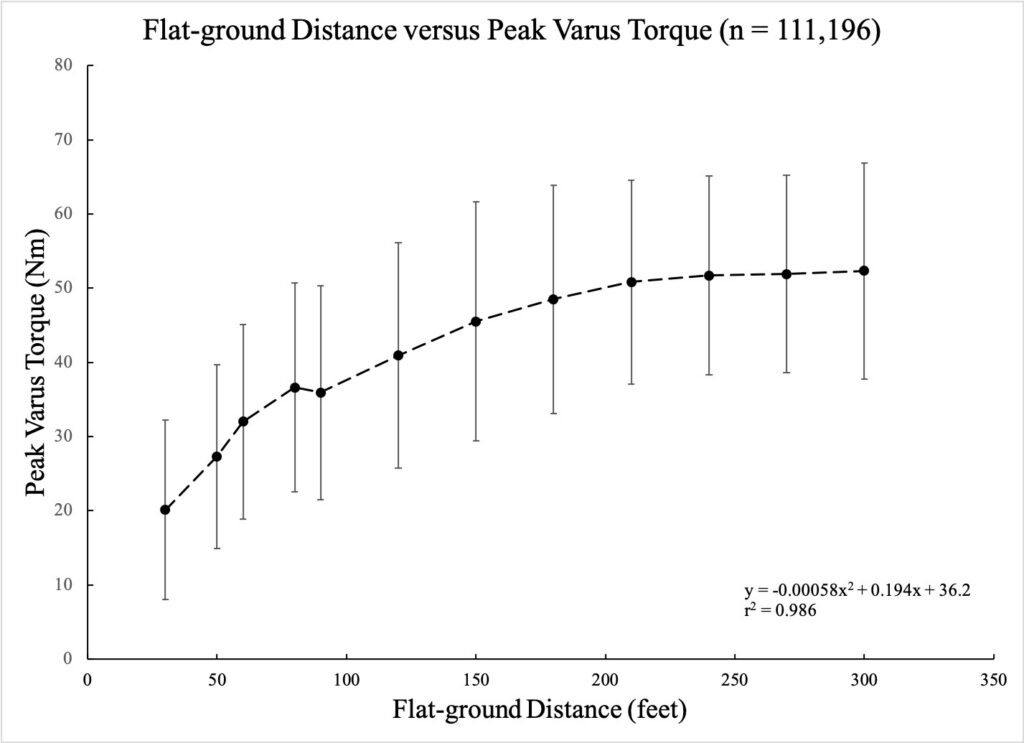
The following is a generalized ITP structure adaptable across throwing sports. It incorporates the workload ramp principles from Reinold et al., 2024 and progression criteria validated in the throwing literature. Baseball pitchers extend this with a mound progression; overhead and field sport athletes adapt distance and mechanics accordingly.
| Step 1 (Wk 1) | 30 ft — 10–15 throws — 50% effort — flat ground — 3x/week |
| Step 2 (Wk 1–2) | 45 ft — 15–20 throws — 50–60% effort — 3x/week |
| Step 3 (Wk 2) | 60 ft — 20–25 throws — 60% effort — 3x/week |
| Step 4 (Wk 2–3) | 75 ft — 25–30 throws — 70% effort — 3x/week |
| Step 5 (Wk 3) | 90 ft — 30 throws — 70–75% effort — 3x/week |
| Step 6 (Wk 3–4) | 120 ft — 30–40 throws — 80% effort — 3x/week |
| Step 7 (Wk 4–5) | Sport-specific distance — 40–50 throws — 90% effort — 3x/week |
| Step 8 (Wk 5–6) | Full distance — full volume — 100% effort — sport integration begins |
The 10% Rule: How to Integrate Exposure
Recall from the 3P Model that Exposure is critical during any rehab or training program. Here is how we can apply Exposure to a throwing program:
- Manipulate only one variable at a time: when advancing distance, hold effort and volume constant; when increasing effort, hold distance and volume constant.
- Cap workload increases at 10% per step: total throwing stress (a product of distance, effort, and volume) should not rise by more than 10% between consecutive sessions or steps.
- Monitor the athlete for 24–48 hours post-session: pain greater than 2/10 or increased soreness within this window is a regression signal, not a normal adaptation response.
- Regress one full step on any pain response: do not modify variables within a step to compensate; return to the prior step and re-establish tolerance before advancing again.
- Return to Phase 3 reassessment if pain persists after regression: a second consecutive pain response indicates a tissue tolerance problem that throwing volume alone cannot resolve; strength and neuromuscular control must be re-evaluated before the ITP continues.
Special Considerations for Surgical Cases
The research is clear that protocol variability is high and outcomes are less predictable than the non-operative literature suggests. Hermanns et al. (2021) reviewed 14 published SLAP repair rehabilitation protocols and found significant inconsistency in phase timelines, exercise selection, and progression criteria. Gouveia et al. (2023) added an important distinction in their systematic review of Bankart repair with return-to-sport rates exceeded 80%, but return to pre-injury performance level was considerably lower. That gap between returning to sport and returning to form is a conversation every post-surgical throwing athlete deserves to have before they resume throwing or full participation.
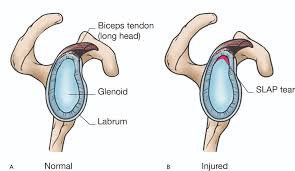
The practical implication is straightforward: the ITP framework in this lesson is the backbone for surgical cases. Timeframes, phases, and loading parameters must be coordinated with the operative surgeon and adapted to the specific repair.
Your objective criteria of strength benchmarks, ROM restoration, functional testing must remain the standard, but when you apply them lives in collaboration with the surgeon’s protocol.
- Return-to-throwing timelines post-surgery range from 12 to 24+ weeks depending on repair type, tissue quality, and individual healing response (Hermanns et al., 2021)
- Fewer than half of published SLAP repair protocols use objective functional testing to determine ITP readiness making your criteria-based approach more rigorous than most published standards
- >80% of athletes return to sport after Bankart repair, but a meaningful proportion do not return to pre-injury performance level (Gouveia et al., 2023)
- RTS rate and RTS quality are not the same metric: be a good steward of information for athletes on both before clearing them for competition
- Always coordinate with the operative surgeon before initiating any phase of the ITP; apply this framework’s objective criteria within their timeline.
Youth Athletes
Youth throwing athletes present a distinct population. Bednar et al., 2021 conducted a systematic review of Little League Shoulder management and found that rest followed by graduated return to throwing yields symptom resolution and return to pre-injury level in over 90% of cases. However, recurrence remains a concern when flexibility deficits persist or when rest is delayed after initial pain onset.
Harada et al., 2017 confirmed that incomplete rest, early return, and persistent posterior shoulder tightness are the primary predictors of recurrence in youth overhead athletes. Your clearance criteria are even more critical in this population.
Major League Baseball has created a great resource for youth baseball players. This resource outlines recommendations for pitch count and rest days based on age brackets.
Considerations to Non-Baseball Athletes
Volleyball, Tennis, Water Polo
- Replace ‘throwing distance’ with overhead serving or attack velocity progression
- Sport-specific mechanics differ: a volleyball spike arm swing differs structurally from a baseball throw; adapt ITP accordingly
- Include sport-specific deceleration training within the court or water environment
- (Fontanez et al., 2023) validated isokinetic and functional testing for shoulder return to sport across overhead sport populations
Quarterback, Lacrosse, Field Hockey
- ITP is typically shorter because distances and volumes are lower than baseball
- Integrate throwing into footwork and movement patterns
- Add decision-making and fatigue tasks at higher effort levels
- Test readiness with drill-based throwing under fatigue before full game clearance
Final Clearance
Completing the ITP is necessary but not sufficient for full competition clearance. (Wilson et al., 2020) demonstrated that athletes 6 months post-shoulder stabilization still showed residual strength and functional deficits on objective testing. The lesson: do not default to time. Default to data.
| ITP Completion | Full ITP completed without pain, compensation, or recurrence |
| Shoulder Strength | ER:IR ratio ≥ 66%; bilateral LSI ≥ 90% (Sgroi et al., 2022) |
| ROM | Within 5° of contralateral total arc; no GIRD > 20° |
| Functional Testing | Closed Kinetic Chain Upper Extremity Stability Test within normative range (Kurz et al., 2023) |
| Pain | 0/10 during and 48 hours after final ITP session |
| Athlete Confidence | Self-reported readiness ≥ 8/10 on return to sport scale |
| Medical Clearance | Physician / team medical staff sign-off where required by protocol |
| Sport Integration | Minimum 1–2 sessions of full practice participation without restriction |
Maintenance: The Often-Missed Final Phase
Return to play is not the finish line. In high-level throwing athletes, shoulder maintenance work must be integrated into the long-term training plan. Failure to do so is a primary driver of the recurrence rates documented in the literature (Harada et al., 2017; Sgroi & Zajac, 2018).
Here is a sample ongoing shoulder maintenance program:
- Rotator cuff maintenance (2x/week minimum) — ER/IR banding, side-lying ER, prone Y/T/W
- Scapular stabilization — bottoms up kettlebell or screwdriver variations.
- Thoracic mobility — rotation and extension to preserve kinetic chain function
- Hip and core integration — because throwing energy starts from the ground up
- Workload monitoring — pitch/throw counts, velocity tracking, RPE-based load management aligned with ACWR principles (Reinold et al., 2024)
Fab Five
- Throwing is a kinetic chain event, never manage it in isolation at the shoulder.
- Objective clearance criteria must be met before throwing begins. Up to 25% of athletes fail these criteria at standard time points.
- The throwing program progressively loads tissue by manipulating distance, effort, and volume, one variable at a time. Workload data validates this structure. (Reinold et al., 2024)
- Post-surgical protocols vary significantly. Timeframes for return to throwing range from 12–24+ weeks. Coordinate with the operative surgeon. (Hermanns et al., 2021)
- Final clearance requires throwing completion + strength benchmarks + functional testing + athlete confidence.
Research
- Reinold M, Dowling B, Fleisig G, et al. An interval throwing program for baseball pitchers based upon workload data. Int J Sports Phys Ther. 2024;19:326-336.
- Dias T, Lerch B, Slowik J, et al. Biomechanical basis of interval throwing programs for baseball pitchers: a systematic review. Int J Sports Phys Ther. 2023;18:1036-1053.
- Sgroi T, Estrada J, Mcelheny K, et al. Utility of objective testing for initiation of a throwing program following shoulder and elbow surgery in competitive baseball players. Orthop J Sports Med. 2022;10.
- Wilk KE, Arrigo CA, Ivey M. Rehabilitation of the shoulder and elbow in the throwing athlete. Clin Sports Med.2024;44(2):249-272.
- Wilk KE, Arrigo CA, Hooks T, Andrews JR. Rehabilitation of the overhead throwing athlete: there is more to it than just external rotation/internal rotation strengthening. PM R. 2016;8(3 Suppl).
- Wilk KE, Yenchak AJ, Arrigo CA, Andrews JR. The Advanced Throwers Ten exercise program: a new exercise series for enhanced dynamic shoulder control in the overhead throwing athlete. Phys Sportsmed. 2011;39(4):90-97.
- Wilson KW, Popchak A, Li R, Kane G, Lin A. Return to sport testing at 6 months after arthroscopic shoulder stabilization reveals residual strength and functional deficits. J Shoulder Elbow Surg. 2020;29(7S):S107-S114.
- Kurz E, Bloch H, Buchholz I, et al. Assessment of return to play after an acute shoulder injury: protocol for an explorative prospective observational German multicentre study. BMJ Open. 2023;13.
- Trasolini NA, Nicholson K, Mylott J, et al. Biomechanical analysis of the throwing athlete and its impact on return to sport. Arthrosc Sports Med Rehabil. 2022;4:e83-e91.
- Sgroi TA, Zajac JM. Return to throwing after shoulder or elbow injury. Curr Rev Musculoskelet Med. 2018;11:12-18.
- Hermanns C, Coda R, Cheema S, et al. Variability in rehabilitation protocols after superior labrum anterior posterior surgical repair. Kans J Med. 2021;14:243-248.
- Gouveia K, Harbour E, Athwal GS, Khan M. Return to sport after arthroscopic Bankart repair with remplissage: a systematic review. Arthroscopy. 2023.
- Harada M, Takahara M, Maruyama M, et al. Outcome of conservative treatment for Little League shoulder in young baseball players: factors related to incomplete return to baseball and recurrence of pain. J Shoulder Elbow Surg. 2017;27(1):1-9.
- Bednar DA, Kay J, Memon M, et al. Diagnosis and management of Little League shoulder: a systematic review. Orthop J Sports Med. 2021;9.
- Wagatsuma K, Kawabata M, Kobayashi H, Miwa T, Iwamoto W. Ultrasound-guided real-time visual biofeedback for internal impingement in a collegiate baseball player: a case report. Cureus. 2025;17.
- Fontánez R, De Jesús K, Frontera W, Micheo W. Return to sports following shoulder injury: clinical evaluation, isokinetic, and functional testing. Curr Sports Med Rep. 2023;22:191-198.