This lesson is built to help you see how performance testing, force diagnostics, and shoulder-specific loading strategies integrate within the Continuum of Return to Play. Testing the shoulder is not simply about isolating the rotator cuff—it’s about understanding how the shoulder expresses force as a system and how that expression changes across phases of return.
Modern tools now allow us to quantify these expressions in real time—peak force, RFD, asymmetry, ROM, long-lever strength—and map these qualities into the athlete’s biological and mechanical needs.
But to interpret these numbers correctly, we must anchor them to the integrated biomechanics we’ve been discussing:
- the rib cage as a moving platform
- the scapula as a mobile socket
- obliques and rectus shaping the rib cage
- serratus linking thorax and scapula
- pelvis mirroring scapula
- iterations of anatomy repeating across the body
Shoulder testing is merely the measurement of how well the system organizes itself.
Performance Testing as a Systems-Based Evaluation
Modern shoulder testing does not measure a joint. It measures coordination, force transfer, and rib cage–scapula–pelvis integration.
The key metrics we collect include:
- Peak Force: how much absolute force the joint can produce
- Rate of Force Development (RFD): how quickly force can be produced
- ER:IR Balance: strength ratios for joint mechanical balance
- Range of motion: shoulder, rib cage, and thorax.
How Technology Quantifies These Systems
Technology is becoming a main stay in training rooms and rehab clinics. When integrated appropriately, they help us improve out programming and keep us accountable. Below are some common, modern technology that are being used to monitor shoulder rehab.
Fixed-Frame Dynamometry
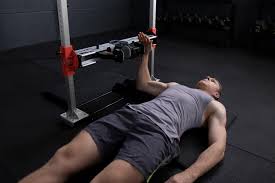
Best for: Isometric strength in leverages that reflect sport positions
Force Plates
Best for: Long-lever force and RFD
Use cases:
- Athletic Shoulder (ASH) Test: I, Y, T positions
- Plyometric push-ups
- Upper-body impulse testing

Handheld Dynamometry (HHD)
Best for: Accessible strength testing when time, space, or equipment is limited
Use cases:
- In-session monitoring
- Early-phase force checks (pain-modulated)
NOTE: a grip strength test protocol assumes that the starting conditions are the same for everyone. Be mindful of resting hand posture and wrist posture and how that may impact length-tension relationships of grip strength muscles. Remember, force is a proxy not only for strength, but joint position too.

How System Mechanics Influence Performance Testing
Previous lessons emphasized that shoulder mechanics are shaped by the thorax, ribs, scapula, pelvis, and breathing. Those same elements show up in objective testing.
Rectus abdominis & pump-handle ribs
If rectus abdomins tone depresses upper ribs, then the scapula literally cannot posteriorly tilt or upwardly rotate atop a compressed rib cage. What you’ll see is:
- reduced overhead ROM
- reduced ER peak force
- reduced long-lever RFD
External obliques & bucket-handle ribs
If external obliques are concentrically biased and the rib cage is compressed with a narrow infrasternal angle, then you’ll see:
- ASH Y and T positions may struggle
- ER:IR balance shifts toward internal rotation
- Trunk rotation tests reveal asymmetry
Serratus anterior
Serratus determines whether the thorax can move on a fixed scapula in long-lever positions. If serratus is underperforming:
- ASH I-position long-lever force drops
- RFD is disproportionately low
- Force transfer into the hand is inefficient
Spine Coupling & Rib IR/ER
Thoracic rotation dictates rib motion. Without rib IR/ER, the scapula cannot orient.
This will show up as:
- asymmetry in ASH positions
- asymmetrical peak force
- changes ROM secondary to position
Testing does not just identify a “weak shoulder”—it also identifies a misaligned system.
Performance Phase — “Max Outputs”
Recall that the Performance Phase of our Continuum is focused on achieving the highest demands of the sport isolated out into specific tests. This is how we create checks and balances to assure the athlete has the requisite capacities to tolerate sport. Relevant testing for the shoulder includes:
- ASH Test full battery (PF + RFD)
- Plyometric push-up metrics
- Peak ER:IR at 90/90
- Range of motion at the shoulder
Exercise Selection Matrices
Pragmatism and organization is critical in your journey in becoming a successful performance therapist. Below I have created several Decisions Matrices that can help you navigate what to do when you see a particular result on a test.
Range of Motion Deficits
| Testing Finding | What It Means | Training Response |
|---|---|---|
| Loss of IR | Ribs in IR position; scapula not posteriorly tilting; increased anterior capsule load | Posterior cuff isos; rib IR drills; thorax rotation work; arm-bar breathing; sidelying windmills |
| Excessive ER | Scapula not upwardly rotating; thorax extended / humerus compensating | Serratus integration; posterior rib expansion; 90/90 iso; upward rotation drills |
| Limited flexion/abduction | Pump-handle ribs compressed (rectus tone); scapular upward rotation blocked | RA downregulation; overhead breathing; serratus reach; closed-chain scapular control |
Peak Force
| Testing Finding | What It Means | Training Response |
|---|---|---|
| Low ER Peak Force | Weak posterior cuff; scapula insufficiently stable; ribs IR-biased | Posterior cuff isometrics; long-lever ER holds; prone Y variations; rib IR work |
| Low IR Peak Force | Subscapularis inhibition; rib ER deficit; poor anterior stability | IR isos; 0° → 45° → 90° progression; trunk rotation with IR load; banded diagonals |
| Weakness in 90° ABD testing | Poor scapular upward rotation; serratus weakness; rib positioning fault | Scapular upward rotation drills; serratus punch progression; overhead isos |
Rate of Force Development
| Low RFD Finding | System Interpretation | Training Response |
|---|---|---|
| Low RFD despite normal PF | Athlete has strength but lacks velocity; thorax cannot stabilize quickly; serratus underperforming | Short-duration max isos (<5 sec); oscillatory isometrics; plyometric push-ups; ballistic band ER |
| Low ASH test RFD | Thorax cannot rotate under load; rib ER lacking; scapula not anchored | Serratus anchor drills; long-lever plyometrics; medball rotational throws; anti-rotation → rotation sequence |
| Side-to-side RFD asymmetry | Rib rotation asymmetry; pelvis-to-thorax power transfer limited on one side | Split-stance acceleration; rotational medball scoop throws; landmine press with rotation |
ER:IR Ratio
| Testing Finding | System Meaning | Training Response |
|---|---|---|
| ER:IR < 0.75 | IR dominance; posterior cuff deficient; scapula anteriorly tilted | Posterior cuff hypertrophy; 90/90 ER isos; ASH T-position loading; thorax flexion/IR drills |
| ER:IR > 1.0 | Excessive ER leverage vs IR; subscap inhibition; rib ER excessive | IR recruitment; serratus + subscap co-contraction; overhead IR work |
Ash Test
| ASH Deficit | Interpretation | Training Response |
|---|---|---|
| Low ASH-I (full abduction) | Long-lever force transfer issue; trunk stabilization deficit | Long-lever isos; anti-extension work; serratus anchoring; medball overhead slams |
| Low ASH-Y | Weak upward rotation; serratus + LT demand | Overhead holds; wall slides with lift-off; prone Y; 135° plane isometrics |
| Low ASH-T | Horizontal force transfer deficit; posterior cuff/sling issue | Horizontal abduction isos; scapular retraction speed; band-resisted row speed reps |
Upper Body Plyometrics
| Plyometric Deficit | Mechanics | Training Response |
|---|---|---|
| Poor impulse | Thorax can’t absorb → release energy; rib stiffness | Elastic push-ups; rhythmic oscillations; rib expansion in decel patterns |
| Side-to-side contact time asymmetry | Trunk rotation asymmetry; scapular depression vs elevation imbalance | Rotational plyo push-ups; alternating hands elevated; asymmetric medball passes |
Shoulder Performance Standards
These numbers represent not just output—but system organization and capacity.
Strength Benchmarks (Relative Force — N/kg)
- ER at 90°: 1.8–2.1 N/kg for elite overhead athletes
- IR at 90°: 2.0–2.2 N/kg
- ER:IR ratio: 0.85–1.0 (position-dependent)
ASH Test Benchmarks
- I-position PF: 1.5–1.6 N/kg
- RFD (0–100 ms): >500 N/s
ROM Benchmarks
- Flex/Abd: ~180°
- ER in 90/90: ~90°
- TROM symmetry (dominant vs non-dominant): within 5°–10°
- GIRD classification: monitor carefully for shifts into pathological ranges
Knowing What Tests Go Where
Throughout this Shoulder section we have reviewed the Continuum and specific testing for each phase. Below I have summarized the complete Continuum and what tests belong in each phase.
| Phase | Appropriate Testing | Purpose of Testing |
|---|---|---|
| HEALTH | PROM / AAROM Low-load IR/ER isometrics (20–30%) Grip strength Neutral-position ROM | Establish safe baselines; assess irritability; monitor early healing tolerance |
| THERAPY | IR/ER peak force in neutral ER:IR ratio Early ASH T-position (short lever) Strength asymmetry checks ROM progressions | Track tissue capacity; guide isolated loading; ensure safe restoration of strength and mobility |
| TRAINING | Peak force at 45°/90° abduction ASH I/Y/T full-lever positions RFD baseline testing Preparatory plyometric metrics• | Determine integrated readiness; monitor kinetic chain function; prepare for controlled velocity |
| PERFORMANCE | Max PF (all angles) Max RFD Plyometric Fast-velocity ER:IR testing | Verify high-output readiness; assess robustness; confirm tolerance for sport-level forces |
| SPORT | Weekly ER/IR PF trends Weekly ROM changes | Manage load and recovery; identify fatigue-driven decline; guide progressions and regressions |
Conclusion
Performance testing is not a checklist—it’s a window into system organization.
When interpreted through functional anatomy, rib cage mechanics, thorax/scapula relationships, and the Continuum of Return to Play, these metrics become a roadmap:
- Health → restore balance
- Therapy → rebuild the part
- Training → integrate the part
- Performance → express maximal capacity
- Sport → tolerate organized chaos
Using objective diagnostics brings clarity.
Using systems thinking brings context.
Using the Continuum brings direction.
Together, they form a powerful model for getting athletes back to high performance—and keeping them there.
Fab Five
- Shoulder testing is a systems evaluation—not a joint evaluation. Metrics like PF, RFD, ER:IR ratios, and ROM reflect how the rib cage, scapula, thorax, pelvis, and breathing strategy coordinate to produce force, dissipate load, and manage rotation.
- Objective diagnostics guide the entire Continuum of Return to Play. Each Continuum phase—Health, Therapy, Training, Performance, Sport—has its own testing priorities, allowing criteria-based progression rather than timeline-based guesswork.
- Technology enables precision and removes subjectivity. Isometric dynamometry, force plates, and ASH testing quantify long-lever strength, explosive capacity, asymmetries, and fatigue responses more accurately than manual testing ever could.
- Training must match the deficit revealed in testing. Low PF requires strength loading, low RFD requires velocity training, ER-dominant ratios require posterior cuff emphasis, and ROM restrictions require rib + thorax interventions—not generic “shoulder exercises.”
- Peak performance emerges only when the entire kinetic system is restored. Achieving sport readiness demands synchronized rib mechanics, scapular control, trunk rotation, pelvic contribution, and high-speed force expression—not just a strong rotator cuff.