Approximate Read Time: 17 minutes
Blood flow restriction (BFR) doesn’t cheat biology rather it works with it. When load isn’t an option, metabolic stress still can be.
What You Will Learn
- How metabolic stress and hypoxia turn low-load exercise into a powerful hypertrophy and strength stimulus during injury rehab
- Why Limb Occlusion Pressure (LOP) and individualized dosing determine the safety and effectiveness of BFR
- How to build evidence-based BFR protocols across post-operative care, tendon rehab, aerobic conditioning, and ischemic preconditioning
Why BFR Matters in Sports Rehab
In every sport I’ve worked in, from the MLS to the NBA, the same early-phase problem shows up: the athlete is motivated, but the tissue is not. Heavy loading is the gold standard for hypertrophy; 70–85% 1RM is where meaningful strength lives. But very few injured athletes can tolerate that, and post-operative protocols will not allow it. The result is predictable: atrophy, frustration, and delays in return-to-play.
BFR breaks this bottleneck by flipping the script. Low-load exercise (as little as 20–40% 1RM) behaves like a strength stimulus. Meta-analyses show that these low loads, when combined with BFR, produce hypertrophy and strength gains rivaling traditional heavy lifting (Loenneke, 2012). Even simple activities like walking or cycling become potent training sessions when blood flow is controlled.
In sport settings, this solves a uniquely modern problem: how to maintain tissue capacity through long seasons, travel schedules, and injury cycles without beating up the athlete in the process.
The Physiology Behind the Illusion
It’s tempting to think of BFR as “cutting off blood flow.” That’s not what happens. The cuffs restrict venous return (the blood trying to escape) while arterial inflow continues. Picture a highway where the entrance ramp is open but the exit is blocked. Traffic slows, pressure builds, and the system is stressed in a way that rapidly alters muscle biology.
Inside the muscle, oxygen becomes scarce. Metabolites accumulate. Lactate rises. The environment turns acidic. All of this forces the body to recruit fast-twitch fibers earlier than it normally would at such light loads. At the same time, cell swelling triggers anabolic signaling, and the endocrine response explodes via growth hormone spikes 200–300% compared to baseline. (Loenneke, 2012).
This cocktail of hypoxia, metabolite accumulation, fiber recruitment, and hormonal signaling mimics what happens during heavy lifting, just without the actual load.
A simple comparison makes the contrast clear:
| Variable | Heavy Strength Training | BFR Strength Training |
|---|---|---|
| Load | 70–85% 1RM | 20–40% 1RM |
| Primary Stimulus | Mechanical tension | Metabolic stress |
| Fiber Recruitment | Gradual, fatigue-based | Early, hypoxia-driven |
| Joint Stress | High | Minimal |
| GH Response | Moderate | Very high |
This explains why BFR has become so central to treating quad atrophy after ACL surgery, patellar tendinopathy during congested seasons, and muscle strains where early load tolerance is restricted.
4 Different Types of BFR
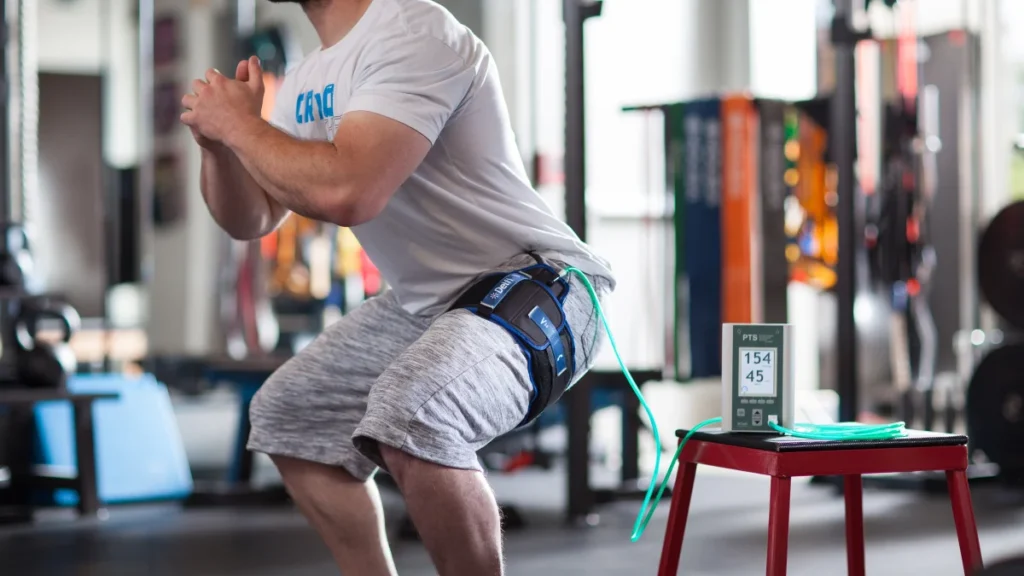
1. BFR for Resistance Training
This is the version most people recognize: the cuffs go on, the load stays light, and the athlete performs a familiar 30-15-15-15 structure. Those 75 total reps aren’t an accident. A meta-analyses shows this pattern consistently drives hypertrophy (Loenneke, 2012). The sets feel almost playful at first, but by the second or third round the athlete hits a deep fatigue normally reserved for heavy training.
2. BFR for Aerobic Training
This one surprises people. Walking at three miles per hour or cycling at 40–50% VO₂max shouldn’t build muscle, but with BFR, it can. Your 8-week progression from incline walking to higher-intensity intervals is a perfect example of how to rebuild aerobic capacity and muscle endurance without mechanical loading. This is a game-changer for early ACL rehab, Achilles, and bone stress injuries.
3. Ischemic Preconditioning (IPC)
Unlike traditional BFR, IPC is performed without movement. At 100% LOP, the limb cycles through five minutes of occlusion followed by five minutes of reperfusion. It feels simple, but the research shows improved mitochondrial efficiency, better sprint performance, enhanced blood flow, and reduced soreness. I’ve used IPC with NBA athletes between playoff games and long road trips; the recovery boost is noticeable for the players.
4. Practical BFR (pBFR)
Elastic wraps or bands mimic the feeling of BFR when pneumatic cuffs aren’t available. Research confirms they can work, but the pressure is imprecise, and arterial occlusion is harder to control safely (Buckner, 2017). A 7/10 tightness scale is the most validated method, yet still variable. For high-stakes athletes or post-op protocols, automated LOP systems remain the gold standard.
When BFR Makes Sense
BFR isn’t a replacement for strength training; it’s a bridge to it. And like any bridge, its value depends on when you use it.
Post-Surgical and Early Rehab
Quad atrophy after ACL reconstruction is one of the most predictable and stubborn problems in sports rehab. Within days of surgery, the quad begins losing size and motor drive. BFR interrupts this decline. Studies show that even within the first week, BFR can preserve muscle cross-sectional area and mitigate early strength loss (Patterson, 2019).
Tendinopathy and Load-Sensitive Tissue
A reactive tendon hates heavy eccentrics during a flare-up. BFR allows athletes to keep training the muscle while sparing the tendon from high strain. Research on patellofemoral pain shows greater strength gains and less pain aggravation when low-load BFR replaces high-load quadriceps work during early rehab (Patterson, 2019).
In-Season or High-Fatigue States
In the NBA, I’ve seen athletes go through stretches where the schedule is congested with back-to-backs and cross-country flights,. BFR gives them a way to maintain muscle and neuromuscular signal without the tissue cost of traditional lifting.
Older Athletes and Longevity Populations
BFR is disproportionately valuable here. Aging joints don’t tolerate high loads well, but the endocrine and hypertrophy response to BFR remains robust. It’s one of the few tools that meaningfully raises tissue capacity without inflaming aging joints. That being said, maintaining muscle mass is important, yet so is absolute strength. BFR should not replace all training in this population, and it can be a nice adjunct to support strength and muscle mass.
Barriers BFR Helps Remove
Every rehab journey contains a handful of bottlenecks. BFR reliably addresses all of them:
- Inability to load due to pain, swelling, or surgical restrictions.
- Rapid atrophy in the early weeks post-injury.
- Fear of reinjury, where light loads feel too “easy” to build confidence.
- Cardiovascular deconditioning during modified weight-bearing phases.
- Tendon reactivity, where load tolerance fluctuates day-to-day.
By letting athletes feel heavy while lifting light, BFR restores not just tissue capacity, but trust in the limb itself.
How BFR Shapes the Rehab Arc
Rehabilitation rarely unfolds in a straight line. It’s a shifting landscape of pain signals, tissue capacity, athlete psychology, and sport timelines. BFR doesn’t replace good programming rather it enhances it. It accelerates what should happen, protects what must happen, and preserves what we can’t afford to lose.

The most productive way to understand BFR is inside the natural rhythm of rehab itself: early → middle → late → return-to-sport. Each phase has different biological goals, different loading needs, and different mental hurdles. BFR serves each one for different reasons.
Early Phase (0–3 Weeks): Protect the Tissue, Preserve the Athlete
Early rehab is equal parts biology and reassurance. The tissue is fragile. Pain is high. Cortical drive is disrupted. The athlete feels disconnected, disuse atrophy can set in, especially in the quadriceps after ACL reconstruction or in the calf after Achilles procedures. Traditional strength work simply isn’t an option. But inactivity is the fastest way to lose the qualities we’re desperately trying to protect.
Why It Works in Early Phase
The science is clear: even in the first week after surgery, low-load BFR preserves muscle cross-sectional area and mitigates strength loss better than conventional rehab. Meta-analyses show that restricting venous outflow increases fast-twitch motor unit recruitment, rapidly building metabolic stress even when loads are light (Loenneke, 2012).
What Early Phase Looks Like in Real Life
Early sessions are simple, almost uncomfortably light:
- Quad sets
- Straight-leg raises
- Seated knee extension isometrics
- Glute bridges
- Mini leg press (if allowed)
But with BFR, these easy movements carry weight, both figuratively and physiologically. Athletes feel the burn. They feel engaged. They feel like they’re training, not “rehabbing.” And that psychological effect is not a small thing. Loss of identity is often the hidden culprit of the early phase.
Benchmarks Before Progressing
While benchmarks vary by injury, the early-phase general indicators are:
- Pain under control at rest
- No abnormal swelling response
- Can complete 75-rep BFR set without setbacks
- Limb Occlusion Pressure (LOP) comfortably tolerated
This is enough to move into more meaningful loading.
Middle Phase (3–8 Weeks): Build Strength Without Breaking Tissue
This phase is where rehab earns its reputation. Athletes feel better, but the tissue is nowhere near ready for the forces of sport. This mismatch is why re-injuries can occur not because athletes are reckless, but because symptoms improve faster than structure. Here, BFR functions like scaffolding: it allows you to build strength without disturbing the remodel.
How to Use BFR in the Middle Phase
This is where the classic 30-15-15-15 model shines. Research shows that 20–40% 1RM paired with BFR can stimulate hypertrophy and strength comparable to heavy lifting (Mattocks, 2018).
The tendon, graft, or healing tissue experiences low strain. The muscle experiences high stimulus. That combination is the Holy Grail of mid-stage rehab.
The Training Shifts Here
Movements become more recognizable:
- Leg press (light)
- Knee extension machine
- Hamstring curls
- Step-ups
- Split squats
- Cycling with BFR
- Treadmill walking incline with BFR
A Note on Tendons
Tendons respond slowly to load, and early eccentrics or plyometrics can irritate them. BFR lets you train the quadriceps or calf hard while sparing the tendon from high tensile demands. Studies on patellofemoral pain show that BFR can actually outperform high-load training early in rehab by reducing pain while still improving strength (Patterson, 2019).
Benchmarks Before Progressing
Think of these as “green lights”:
- Full range of motion with minimal pain
- Walking without compensation
- Single-leg squat with symmetrical control
- Strength improving meaningfully on BFR sets
- Consistent tolerance to 3 BFR sessions/week
When these appear together, the athlete is ready to transition from metabolic strength to mechanical strength.
Late Phase (8–16 Weeks): Reintroduce Load and Restore Athletic Reality
Once tissue capacity improves, we begin shifting away from metabolic stress and toward mechanical stress with eccentrics, heavier loading, dynamic control, and eventually plyometrics. BFR doesn’t disappear here. It becomes the assist, not the driver.
Think of it like the spotter on a heavy bench press. It’s not doing the work, but it makes the work safer, more consistent, and more complete.
Why BFR Still Matters
Late-phase programming is where asymmetries hide. An athlete might squat 225 lbs, but compensate subtly through the trunk or hip without even realizing. BFRI provides a high metabolic stimulus on days when the program demands reduced mechanical loading especially in-season.
Training Looks Different Now
This phase blends traditional strength with BFR-supported accessories:
- Heavier squatting or deadlifting
- Split squat progressions
- Step-downs and multi-planar movement
- Controlled eccentrics
- Deceleration work
- Introduced plyometrics (submaximal → maximal)
Then BFR is layered onto targeted areas:
- Single-leg extensions
- Hamstring curls
- Calf raises
- Walking or cycling for conditioning
Benchmarks Before Progressing
The late phase is more objective:
| Domain | Benchmark |
|---|---|
| Strength | 80–90% limb symmetry on machine-based testing |
| Tendon load tolerance | Able to tolerate plyometric exposure without reactivity |
| Aerobic capacity | Can complete BFR aerobic intervals at prescribed incline/speed |
| Neuromuscular control | Single-leg hop mechanics controlled and symmetrical |
| Psychological readiness | Athlete reports trust in limb during unexpected movements |
Return-to-Sport Phase: Chaos, Speed, and The Final 10%
The final stage is includes running, cutting, accelerating, and reacting. In other words, the exact environment where many injuries occur. This phase demands the highest tissue tolerance and the most nuanced programming.
Here, BFR is no longer the star. It is the support system
Where BFR Fits in Return-to-Sport
- On days when field work is heavy, BFR provides strength without added mechanical load.
- On recovery days, BFR aerobic sessions support healing through improved perfusion and repeated reactive hyperemia.
Benchmarks for Return-to-Sport Clearance
The athlete must hit all of these:
- >90% limb symmetry index on strength and hop tests
- Efficient deceleration mechanics on high-speed video
- Ability to tolerate full-speed sprinting with no pain response
- No swelling for 24 hours post-training
- Sport-specific drills performed with spontaneity, not caution
When these align, the rehab is nearly complete. BFR helped preserve capacity when we needed it, enhanced development when we could use it, and supported performance when tissue was vulnerable.
5 Common Mistakes with BFR Programming
- The “Too Heavy, Too Soon” Trap: BFR only works when load stays low. Once athletes feel good, they want to add weight. But high mechanical load defeats the purpose—and increases risk.
- Using Arbitrary Pressures: Cuff pressure must be individualized. LOP is not negotiable. Studies show that using the same pressure for all athletes dramatically alters safety and effectiveness (Mouser, 2017).
- Applying Cuffs Too Distally: Cuffs belong at the proximal arm or thigh. The further down the limb, the more unpredictable the pressure distribution.
- Overloading Tendons in Reactive Phases: Heavy eccentrics + BFR is a bad combination early. BFR should offload tendons, not amplify stress.
- Using BFR Every Day: More isn’t better. Adaptation requires both stimulus and recovery. The research-supported sweet spot is 2–4 sessions per week, depending on phase.
Bringing It All Together: What BFR Really Gives Us
Blood Flow Restriction isn’t a shortcut. It isn’t a hack. And it certainly isn’t a replacement for the strength work that ultimately defines return-to-sport. What BFR is and what the last decade of research makes impossible to ignore. It is a tool for solving one of rehab’s problems: how to create a meaningful training stimulus when tissue can’t tolerate meaningful load.
Across early, middle, late, and return-to-sport phases, BFR adapts to the need of the moment. In the beginning, it slows atrophy and restores neuromuscular engagement. In the middle, it builds strength without overload. In the late stages, it shores up deficits heavy lifting sometimes hides. And once sport re-enters the equation, BFR becomes a recovery tool
What makes BFR special is not that it’s flashy, but that it’s useful. It fills the gaps that traditional rehab leaves open. It protects the athlete’s physiology during vulnerable windows and leverages biology in ways that simple exercise selection can’t. It reinforces a simple truth: strength is not only built under a barbell. Strength is built through stimulus and stimulus comes in many forms.
5 Keys to Blood Flow Restriction Rehab
- Light Loads Can Drive Heavy Adaptation: BFR creates a high-intensity internal environment with low-intensity external stress, an ideal combination for early and mid-stage rehab.
- Individualized Pressure Is Non-Negotiable: Cuff width, limb size, and systolic blood pressure change the occlusion response. Limb Occlusion Pressure (LOP) isn’t a suggestion; it’s the foundation of safe and effective BFR.
- Metabolic Stress Is a Tool—Not a Crutch: BFR should complement traditional loading, not replace it. As tissue tolerance grows, mechanical load must re-enter the program.
- Use BFR Strategically Across the Season: In-season or congested schedules often create recovery debt. BFR allows athletes to maintain strength when heavy lifting isn’t feasible.
- Think in Phases, Not in Exercises: BFR looks different at every stage of rehab. The question isn’t “Should I use BFR?” rather the question is “What does BFR help me accomplish right now?”
Watch More Like This
Read More Like This

Related Podcasts

References
Abe T, Beekley MD, Hinata S, Koizumi K, Sato Y. Day-to-day change in muscle strength and MRI-measured skeletal muscle size during 7 days KAATSU resistance training: a case study. Int J KAATSU Train Res. 2005;1(2):71–76.
Abe T, Fujita S, Nakajima T, et al. Effects of low-intensity cycle training with restricted leg blood flow on thigh muscle volume and VO2max in young men. J Sports Sci Med. 2010;9:452–458.
Abe T, Kawamoto K, Yasuda T, Kearns CF, Midorikawa T, Sato Y. Eight days KAATSU-resistance training improved sprint but not jump performance in collegiate male track and field athletes. Int J KAATSU Train Res. 2005;1(1):19–23.
Beekley MD, Sato Y, Abe T. KAATSU-walk training increases serum bone-specific alkaline phosphatase in young men. Int J KAATSU Train Res. 2005;1(2):77–81.
Buckner SL, Dankel SJ, Counts BR, et al. Influence of cuff material on blood flow restriction stimulus in the upper body. J Physiol Sci. 2017;67(2):207–215.
Clarkson MJ, Conway L, Warmington SA. Blood flow restriction walking and physical function in older adults: a randomized control trial. J Sci Med Sport. 2017.
Dankel SJ, Jessee MB, Abe T, et al. The effects of blood flow restriction on upper-body musculature located distal and proximal to applied pressure. Sports Med. 2016;46:23–33.
Fujita S, Brechue WF, Kurita K, et al. Increased muscle volume and strength following six days of low-intensity resistance training with restricted muscle blood flow. Int J KAATSU Train Res. 2008;4(1):1–8.
Hughes L, Patterson SD, Haddad F, et al. Blood flow restriction training in clinical musculoskeletal rehabilitation: a systematic review and meta-analysis. Br J Sports Med. 2017;51(13):1003–1011.
Jessee MB, Buckner SL, Dankel SJ, et al. The influence of cuff width, sex, and race on arterial occlusion: implications for blood flow restriction research. Sports Med. 2016;46:913–921.
Laurentino GC, Ugrinowitsch C, Teixeira EL, et al. The effect of cuff width on muscle adaptations after blood flow restriction training. Med Sci Sports Exerc. 2016;48(5):920–925.
Loenneke JP, Fahs CA, Rossow LM, et al. Blood flow restriction pressure recommendations: a tale of two cuffs. Front Physiol. 2013;4:249.
Loenneke JP, Wilson JM, Wilson GJ, Pujol TJ, Bemben MG. Potential safety issues with blood flow restriction training. Scand J Med Sci Sports. 2011;21(4):510–518.
Loenneke JP, Wilson JM, Wilson GJ, et al. A mechanistic approach to blood flow occlusion. Int J Sports Med.2010;31(1):1–4.
Loenneke JP, Wilson JM, Goto K, et al. Low intensity blood flow restriction training: a meta-analysis. Eur J Appl Physiol.2012;112:1849–1859.
Mattocks KT, Jessee MB, Dankel SJ, et al. The application of blood flow restriction: lessons from the laboratory. Curr Sports Med Rep. 2018;17(4):129–134.
Mouser JG, Laurentino GC, Dankel SJ, et al. A tale of three cuffs: the hemodynamics of blood flow restriction. Eur J Appl Physiol. 2017;117:1493–1499.
Patterson SD, Hughes L, Warmington S, et al. Blood flow restriction exercise: considerations of methodology, application, and safety. Front Physiol. 2019;10:533.
Slysz J, Stultz J, Burr JF. The efficacy of blood flow restricted exercise: a systematic review & meta-analysis. J Sci Med Sport. 2016;19(8):669–675.
Takarada Y, Tsuruta T, Ishii N. Cooperative effects of exercise and occlusive stimuli on muscular function in low-intensity resistance exercise with moderate vascular occlusion. Jpn J Physiol. 2004;54:585–592.
Yasuda T, Fujita S, Ogasawara R, et al. Effects of low-intensity bench press training with restricted arm muscle blood flow on chest muscle hypertrophy. Clin Physiol Funct Imaging. 2010;30:338–343.