So far in the 3P Injury Prevention Toolkit we have movement and strength. Today, we will talk about the third tool – fitness.
fit·ness: the quality of being suitable to fulfill a particular role or task.
While fitness is often associated with physical conditioning, its true definition—”the quality of being suitable to fulfill a particular role or task”—encompasses so much more. Fitness is a multi-faceted concept, integrating physical, technical, tactical, and psychological elements to create well-rounded performance and health. More simply put, how prepared are you to handle a wide variety of stress?
Enhancing the physical aspect of fitness lies in understanding how the body’s energy systems function, particularly through heart rate zone training and improving VO2max. These metrics not only predict performance and recovery but are also essential markers of injury risk and longevity.
Let’s break down how heart rate zones and VO2max impact fitness and why they’re critical to achieving your goals, whether you’re an athlete improving performance, recovering from an injury, or simply looking to stay active to enhance longevity.
Fitness: the 3P Multidimensional Approach
In the 3P Toolkit, fitness goes beyond physical conditioning, encompassing physical, technical, tactical, and psychological preparedness.
- Physical Preparedness involves optimizing energy systems—alactic (explosive), anaerobic (short, intense), and aerobic (sustained)—to meet the demands of sport and daily life. For example, Zone 2 training helps soccer players build endurance and recover efficiently during games.
- Technical Preparedness focuses on sport-specific skills like dribbling or shooting, which must be trained under game-like conditions to ensure we can perform under pressure. To be physically prepared alone is not enough to be fit for competition. Technical skills improve our efficiency at an activity, whether that is improved biomechanics in running or setting up the correct systems to run a business.
- Tactical Preparedness highlights the importance of game awareness and strategy. Elite athletes often excel by conserving energy and maximizing output through smarter play. For instance, Lionel Messi and Lebron James’ ability to read the game allow them to minimize physical effort while maximizing impact. Or consider YouTube star Mr. Beast who has stated he can generate 20 million followers on YouTube in 6 months from scratch – something many of us may never achieve in a lifetime.
- Psychological Preparedness emphasizes mental resilience, focus, and decision-making. Simulating high-pressure scenarios in training prepares us to perform confidently during critical moments. During high physical stress, it is the psychological resilience that ultimately gets us through to the other side.
Fitness, in this holistic sense, integrates these dimensions to enhance performance and reduce injury risk.
VO2 max – The Gold Standard
VO2max, or maximal oxygen uptake, measures your body’s ability to use oxygen during intense exercise. It’s a critical indicator of aerobic capacity and a predictor of long-term health outcomes.
- Injury Prevention:
Athletes with higher VO2max values are less prone to injuries. Why? Better aerobic capacity delays fatigue, which reduces biomechanical errors and poor coordination—two major contributors to musculoskeletal injuries. - Health Benefits:
Higher VO2max levels correlate with reduced risk of cardiovascular disease, metabolic syndrome, and all-cause mortality. A study of over 122,000 adults found that elite VO2max levels reduced mortality risk by over 80% compared to those with low VO2max. It’s not just about living longer but living better—maintaining functional capacity and independence as you age. - Slowing the Decline:
VO2max naturally declines with age, but regular aerobic training can significantly slow this process. Improving VO2max extends your healthspan, allowing you to perform at a higher level longer. - How to Measure It:
VO2max is typically assessed in a lab using graded exercise tests, but field-based estimates like a Timed 1-Mile Run or a Yo-Yo intermittent recovery tests provide accessible alternatives.
Lessons Learned from Research
Improving VO2max and aerobic fitness is essential for both health and performance, with research highlighting its impact on reducing all-cause mortality and injury risk. Studies across diverse populations, from elite athletes to military personnel, consistently show that better cardiorespiratory fitness enhances resilience to physical stress and supports long-term health outcomes.
- Cardiorespiratory Fitness and Mortality The largest study of its kind demonstrated that higher aerobic fitness levels significantly reduced all-cause mortality. Even modest improvements in VO2max were associated with marked health benefits .
- Aerobic Fitness and Injury Risk Elite Gaelic football players with higher aerobic fitness levels showed significantly lower injury rates during spikes in training load. Aerobic capacity buffered the impact of high training load increases, reducing the likelihood of overuse injuries.
- Energy System Development and Functional Fitness In military populations, lower cardiorespiratory endurance (e.g., poor performance on timed shuttle runs) strongly predicted musculoskeletal injuries. Targeted training to improve aerobic fitness reduced injury rates, confirming the critical role of cardiovascular health in injury prevention.
Energy Systems: The Science of Fitness

Your body relies on three energy systems—alactic, anaerobic, and aerobic—to fuel activity. Each system plays a unique role depending on the intensity and duration of exercise.
These systems are constantly working in harmony. They are not simple on-off switches. Depending on the volume or intensity, one system will be the priority until that volume or intensity changes then another will become the priority system. We can think of energy systems more as a conductor of an orchestra rather than an electrician operating a switchboard.
- Alactic (PCr) System
- Key Characteristics: Immediate energy for short bursts (10–15 seconds), such as sprints or jumps.
- Example: The system powers quick, explosive movements and can be enhanced by creatine supplementation.
- Anaerobic Glycolytic System
- Key Characteristics: Supplies energy for moderate-to-high intensity efforts (30 seconds to 2 minutes).
- Misunderstanding Lactate: Lactate is not the enemy—it’s an energy shuttle that fuels recovery and performance.
- Example: Activities like 400-meter sprints rely heavily on this system.
- Aerobic System
- Key Characteristics: Supports prolonged, low-to-moderate intensity efforts using oxygen to fuel energy production.
- Example: Distance running or steady-state cycling improves this system’s efficiency, essential for recovery and endurance.
All three systems work together dynamically, with one taking precedence based on the demands of the activity.
Heart Rate Zone Training: The Art of Fitness
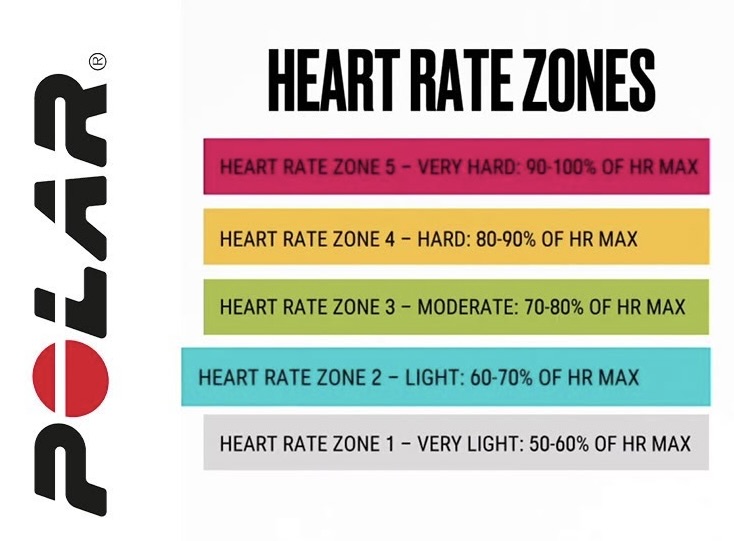
Heart rate zone training allows you to tailor your workouts to specific physiological adaptations, targeting different energy systems for optimal performance and recovery.
- Lower zones (1-2) enhance endurance and recovery.
- Middle zones (3-4) improve lactate clearance and sustained effort.
- Higher zones (5) improve cardiac power and VO2max
5 Traditional Heart Rate Zones
- Zone 1: Recovery (50–60% of max HR)
- Purpose: Active recovery, parasympathetic activation, and mitochondrial efficiency.
- Example: Light walking or slow cycling to promote recovery between intense training sessions.
- Zone 2: Aerobic Capacity (60–70% of max HR)
- Purpose: Builds aerobic endurance, improves mitochondrial density, and increases stroke volume.
- Example: Steady-state jogging or moderate cycling for endurance athletes.
- Key Insight: Zone 2 training is foundational for improving cardiovascular health and longevity. It’s a low-risk, high-reward approach suitable for all fitness levels.
- Zone 3: Tempo (70–80% of max HR)
- Purpose: Develops the lactate threshold, improves carbohydrate utilization, and enhances cardiovascular efficiency.
- Example: Tempo runs or high-effort cycling sessions to prepare for higher-intensity efforts.
- Zone 4: Threshold Training (80–90% of max HR)
- Purpose: Increases lactate clearance, anaerobic capacity, and VO2max.
- Example: Interval training or fast running to push the boundaries of your aerobic and anaerobic systems.
- Key Insight: Zone 4 helps athletes sustain high-intensity efforts for longer, essential for competitive performance.
- Zone 5: Maximal Effort (90–100% of max HR)
- Purpose: Boosts anaerobic power, neuromuscular efficiency, and maximal performance.
- Example: Sprinting or all-out rowing for short durations to enhance explosive power and speed.
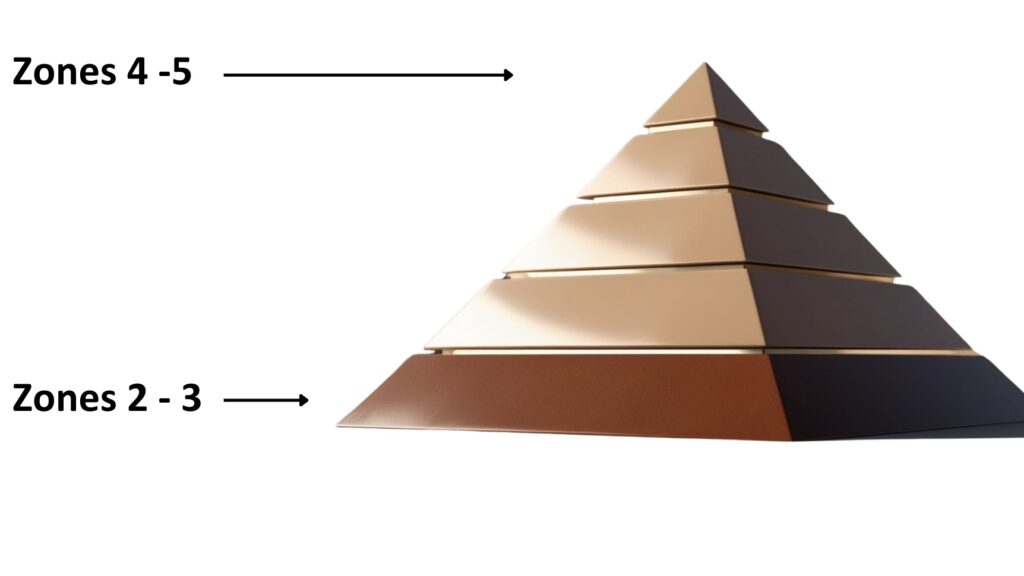
If the base of a Pyramid is zone 2, then the Top of the Pyramid is Zone 5.
Zone 2 training is foundational for maintaining cardiovascular health and reducing injury risk. Studies confirm that moderate-intensity aerobic work lowers injury rates by improving tissue recovery and overall resilience.
On the other end of the continuum, improving VO2max through Zone 4-5 training will raise the magnitude of our fitness. Utilizing the analogy of a pyramid, we can simply categorize heart rate zone training into two main categories:
- Zone 2-3 training are the number of blocks at the base of the pyramid
- Zone 4-5 training are the blocks stacked at the top of the pyramid.
The height of the pyramid is determined by the number of blocks at the top, but the pyramid can only go so high depending on the number of blocks at the base. Both low-intensity and high intensity conditioning are needed to improve the height of the pyramid.
How to Improve Fitness
Improving fitness requires a targeted approach that combines science-backed strategies with consistent effort. Below are practical methods to enhance aerobic capacity, boost VO2max, and optimize recovery, helping you build a more resilient and high-performing body.
Build Aerobic Capacity with Zone 2
Zone 2 training is foundational for improving cardiovascular health, endurance, and recovery.
- What to Do: Incorporate steady-state exercises like jogging, cycling, or swimming at 60–70% of your max heart rate.
- Duration: Aim for 30–90 minutes per session with a target of 2-3 hours each week.
- Why It Works: Enhances mitochondrial density, capillarization, and stroke volume, making it essential for sustained performance and longevity.
Threshold Training with Zone 3
Training near your lactate threshold prepares your body to handle higher intensities without fatigue. Zone 3 training helps improve some of the buffering capabilities to help maintain appropriate blood pH and homeostasis. A good indicator of Zone 3 is being just below the level of “feeling the burn” during exercise.
- What to Do: Perform tempo runs or intervals at 70–80% of your max heart rate.
- Duration: 4 – 8 reps and each rep are 1-2 minutes. Take a 1–2-minute rest between efforts to maintain a 1:1 work-to-rest ratio. Perform 1-2 sessions each week.
- Why It Works: Increases your ability to buffer lactate, improving sustained performance during intense activities.
Increase VO2-Max with Zones 4-5
VO2max training maximizes your aerobic capacity and enhances your ability to perform at high intensities.
- What to Do: Use interval training (e.g., 30 – 60 seconds sprints with 2-3 minute rest) at 85-90% of your max heart rate.
- Reps: Perform 4–8 intervals once a week.
- Why It Works: Stimulates both aerobic and anaerobic systems, increasing your heart and lungs’ capacity to deliver oxygen efficiently.

Utilize Zone 1 for Active Recovery
Active recovery sessions between intense workouts reduce fatigue and improve recovery. If you are like me and have a tough time not moving everyday, then Zone 1 is a great tool to use to satisfy your craving to move while also enhancing recovery.
- What to Do: Engage in light activities like walking, yoga, or cycling at 50–60% of your max heart rate.
- Duration: 20–40 minutes, as needed.
- Why It Works: Promotes parasympathetic activation, aiding in recovery and reducing stress.
Strengthen the Alactic System with explosive Movements
Train your body for short bursts of power by targeting the alactic, or phosphocreatine (PCr), system.
- What to Do: Include sprints, jumps, or heavy lifts with maximal effort for 8 – 10 seconds.
- Rest: Allow 2–3 minutes of full recovery between efforts.
- Why It Works: Improves your ability to perform high-intensity, short-duration activities critical for explosive sports.
Measure Progress with Regular Vo2-Max Testing
- Use Tools: Heart rate monitors and fitness apps can help you stay in your target zones.
- Field Tests: Perform periodic assessments like the Timed 1-Mile Run or lab-based VO2max test on a metabolic cart.
- Why It Works: Tracking ensures your training remains targeted and effective, allowing adjustments as needed.
Leverage Nutrition to Optimize Recovery
Proper fueling is essential for optimizing all energy systems. It can not only enhance your energy output during training but also aid in managing inflammation to accelerate recovery.
- Carbohydrates: Provide energy for anaerobic and aerobic efforts.
- Proteins: Aid in recovery and muscle repair.
- Micronutrients: Include vitamins and minerals to maintain overall health and recovery.

Why Fitness Matters
Fitness is a dynamic, science-driven concept that integrates energy system development with targeted heart rate zone training. By understanding and applying these principles, you can:
- Reduce injury risk through better recovery and delayed fatigue.
- Improve longevity by maintaining VO2max and cardiovascular health.
- Optimize performance with tailored training that targets specific physiological adaptations.
Stay tuned for the next tool in the 3P Injury Prevention Toolkit: Exposure, where we’ll explore how progressive stress can drive performance improvements while minimizing injury risk.
Sincerely,
Dr. Adam Loiacono

Finding Small Wins Podcast!
Fitness is multifaceted, so how can we leverage breathwork and learn how to train it to improve fitness?
Check out Episode 017 with World Series Champ, Andrew Hauser, to learn more!
- Mandsager K, Harb S, Cremer P, et al. Association of cardiorespiratory fitness with long-term mortality among adults undergoing exercise treadmill testing. JAMA Netw Open. 2018;1(6):e183605. doi:10.1001/jamanetworkopen.2018.3605
- Lisman PJ, de la Motte SJ, Gribbin TC, et al. A systematic review of the association between physical fitness and musculoskeletal injury risk: part 1—cardiorespiratory endurance. J Strength Cond Res. 2017;31(6):1744-1757.
- Malone S, Roe M, Doran DA, Gabbett TJ, Collins KD. Aerobic fitness and playing experience protect against spikes in workload: the role of the acute:chronic workload ratio on injury risk in elite Gaelic football. Int J Sports Physiol Perform. 2016. doi:10.1123/ijspp.2016-0090