Roadmapping & Reverse Engineering a Hamstring Strain
READ: 15 minutes
WRITE: 30 minutes
WATCH: 23 minutes
Introduction
The hamstrings are a masterpiece of muscular architecture including strength, flexibility, and coordination. But despite relentless efforts by researchers and practitioners, hamstring injuries continue to plague athletes.
Using a Grade II hamstring strain as a case study for this article, we will take a deep dive into the hamstring muscle group’s anatomy, its biomechanical nuances such as fiber orientation and architectural gear ratios, and the perspective of isometric vs eccentric muscle actions during terminal leg swing. These insights help us understand how the hamstrings function and fail during the intense demands of athletic performance.
Muscle Attachments
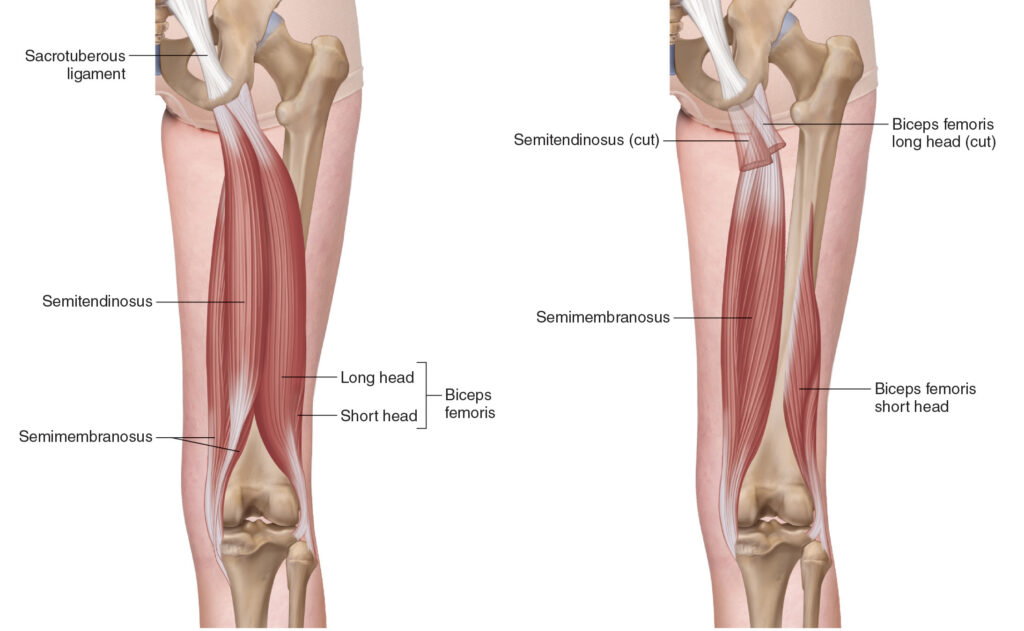
Imagine the hamstrings as a dynamic suspension system in a car, linking the pelvis to the lower leg, absorbing shocks, and propelling movement. Each muscle within this group has a specific starting and ending point, giving it a unique role:
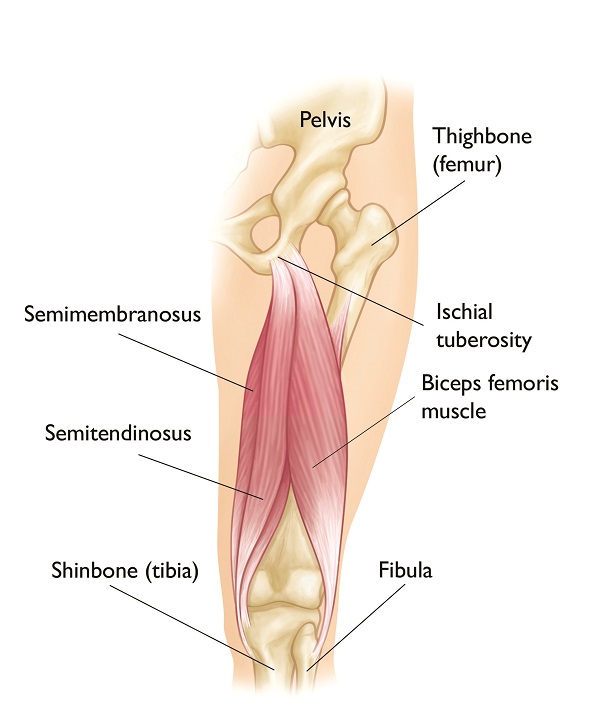
- Biceps Femoris: The long head originates from the ischial tuberosity, the bony seat of the pelvis, and inserts on the lateral side of the fibular head. Its shorter sibling, the short head, bypasses the hip entirely, anchoring itself on the femur before joining the long head at the fibula. Together, they act like the reins of a horse, pulling the leg backward and steering external rotation.
- Semitendinosus: This rope-like muscle begins at the ischial tuberosity and ends on the medial tibia, part of the pes anserinus, a tendinous trio that stabilizes the inner knee like guy wires on a tent pole.
- Semimembranosus: Broader and flatter, it also springs from the ischial tuberosity and fans out to the posterior medial tibia, acting as a stabilizer and powerful extender.
Proximal Attachment and Sacrotuberous Ligament
The long head of the biceps femoris and semitendinosus share a close relationship with the sacrotuberous ligament, a fibrous band that extends from the pelvis to the sacrum. Think of it as a built-in seatbelt, transferring forces from the hamstrings to the spine while anchoring the pelvis during movement. This structural continuity explains why hamstring injuries often involve the pelvis, not just the thigh.
Innervation
The hamstrings are a united team with a divided playbook. Most of them are controlled by the tibial branch of the sciatic nerve, while the short head of the biceps femoris is served by the common fibular branch. This dual innervation reflects their multifaceted roles across hip and knee joints.

Functional Anatomy
Sagittal, Frontal, and Transverse Actions
In the sagittal plane, the hamstrings act as the body’s turbochargers, generating both power and control. As hip extensors, they work with the gluteus maximus to propel the body forward during running or jumpng. As knee flexors, they counteract the quadriceps, decelerating the shin during the swing phase of gait, much like a parachute slowing a racing car.
Though the hamstrings aren’t headliners in the frontal plane, they quietly stabilize the pelvis during single-leg activities like walking or lunging. Imagine balancing a tray of drinks on a wobbly table; the hamstrings, along with other stabilizers, keep the tray steady despite shifting forces.
In the transverse plane, the biceps femoris acts like a door hinge, rotating the tibia outward when the knee bends, while the semitendinosus and semimembranosus act as the opposing hinge, rotating the tibia inward. This coordinated effort ensures smooth transitions during pivoting or rotational movements.
Gaining an appreciation for the various muscle actions across different planes of motion showcases how static posture can influence the capabilities of the hamstring group. For example, a pes cavus foot is often accompanied with an externally rotated tibia. Therefore, the resting length-tension relationship of the distal hamstrings are impacted. The biceps femoris becomes shortened while the semi-group becomes lengthened.

Open vs. Closed Chain Dynamics
In the Open Chain (e.g., kicking), where the foot is free, the hamstrings act as brakes, controlling the leg’s motion to prevent overextension, like the shock absorbers of a bicycle.
In the Closed Chain (e.g., squatting), where the foot is fixed, the hamstrings pull double duty, extending the hip and stabilizing the knee, much like the cables in a suspension bridge holding everything together.
Architectural Gear Ratios and Muscle Slack
Fiber Orientation: Proximal vs. Distal
The hamstrings are architecturally complex, with significant differences in fiber orientation from their proximal origins to distal insertions. Proximally, fibers are shorter and oriented more obliquely, favoring high-force production. Distally, the fibers are longer and more parallel, optimizing for speed and range of motion. This architectural gradient allows the hamstrings to function efficiently across multiple planes and joint actions. For instance, the semimembranosus, with its broad, proximal origin, provides powerful hip extension, while the biceps femoris, with its longer distal fibers, excels in rapid deceleration during sprinting – an action that requires large amount of force to decelerate a lower limb.
Consider the the Force-Velocity Curve and the kangaroo vs. gorilla analogy: muscle fibers in SERIES are velocity-dominant – the KANGAROO – whereas PENNATED muscle fibers are force-dominate – the GORILLA.

Architectural Gear Ratios and Function
The concept of architectural gear ratio (AGR)—the ratio of muscle velocity to fiber velocity—further illuminates the hamstrings’ dual roles. High AGRs are associated with rapid shortening and speed, while low AGRs favor force production. During the terminal swing phase of running, the hamstrings exhibit a high AGR, allowing the muscle-tendon unit to decelerate the leg efficiently without excessive strain on the fibers. This gear-shifting capability is akin to a car downshifting to navigate a steep hill—prioritizing control over speed.
What is Muscle Slack?
Muscle slack refers to the delay between muscle activation and force transmission due to the compliance of the muscle-tendon unit. When slack exists in the system, the contractile element (muscle fibers) must first align and tension the series elastic element (tendons and connective tissue) before force can be transmitted to the skeleton. This mechanical delay can impact performance, particularly in rapid movements like sprinting.
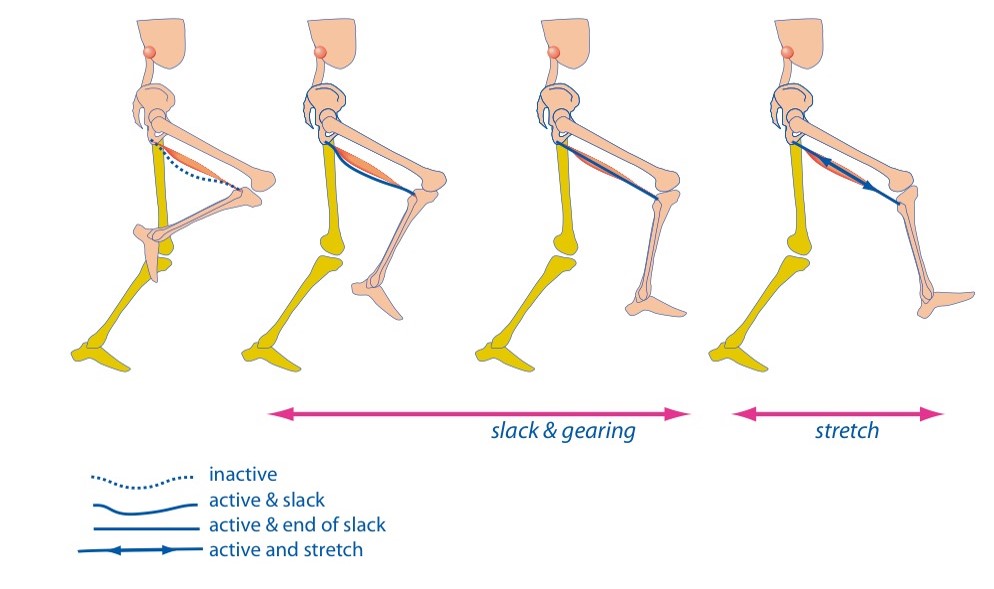
Impact on High-Speed Running
During the terminal swing phase, the hamstrings must decelerate the forward-moving tibia while preparing for ground contact. Muscle slack complicates this task, requiring the hamstrings to generate force rapidly. If slack is not efficiently managed, the muscle-tendon unit is at greater risk of strain, particularly in the biceps femoris, which is more prone to injury due to its shorter fascicles and higher pennation angles.
Implications for Training
Traditional eccentric exercises, like the Nordic hamstring curl, may not fully address the issue of muscle slack. Instead, high-intensity isometric exercises, which mimic the hamstrings’ isometric action during terminal swing, may better condition the muscle-tendon unit for high-speed demands. This approach aligns with dynamic systems theory, which emphasizes task-specific training to enhance performance.
Read About Others’ Transformations
“The Performance Therapy Mentorship was transformative. The combination of weekly modules, practical resources, and engaging lessons made complex topics easy to understand and apply. It’s a must for anyone looking to advance their career in sports rehab!”
Alex R. Athletic Trainer

“This mentorship program simplified complex concepts in a way that made them immediately applicable. The lessons on energy systems and periodization gave me a new perspective on how to structure training and manage workload effectively. It’s been a game-changer for my practice.”
Mike H. Physical Therapist

Revisiting the Terminal Swing Phase
The terminal swing phase of running is a critical period in the gait cycle where the hamstrings are tasked with balancing contradictory demands of deceleration and stability. This phase occurs just before foot contact, as the leg transitions from an anteriorly driven projectile to a grounded lever. The biomechanical and neuromuscular challenges in this moment make it one of the most perilous periods for hamstring integrity.
Dynamic Lengthening and Force Absorption
Traditionally, the terminal swing phase has been understood as a period of eccentric contraction, where the hamstrings actively lengthen while producing force to decelerate the swinging leg. This perspective is supported by the observation that the biceps femoris, the most commonly injured hamstring muscle, undergoes significant musculotendinous unit (MTU) elongation during this phase. The muscle is required to both control knee extension and stabilize the hip, leading to high levels of mechanical strain.
Rethinking Eccentrics: The Isometric Model
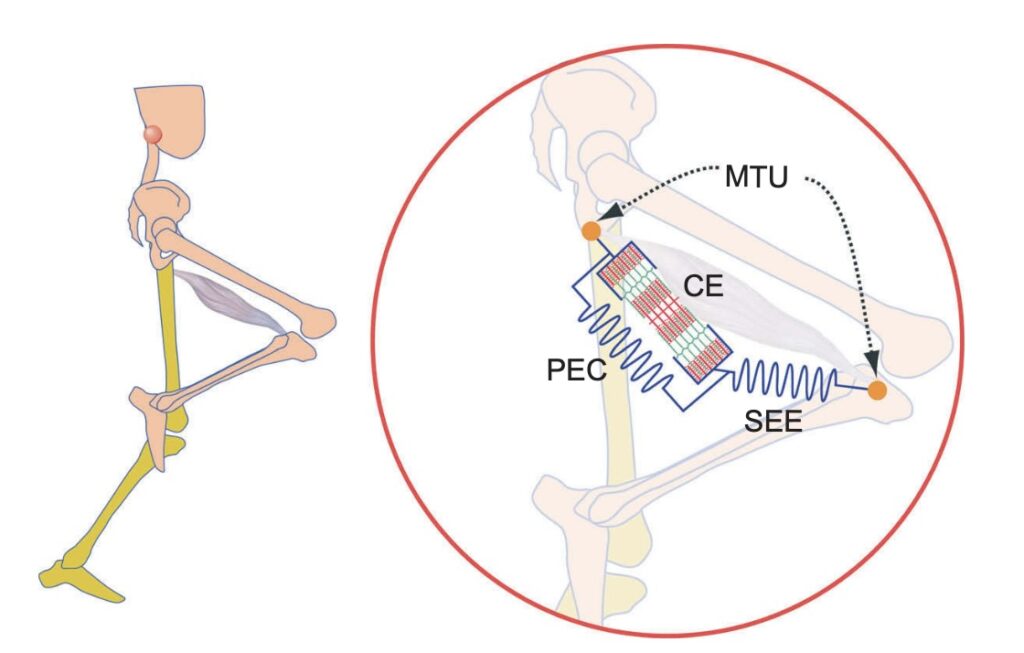
Recent research has nuanced this understanding, suggesting that the contractile element (CE) of the hamstrings—specifically, the muscle fibers themselves—may act predominantly isometrically during the terminal swing phase. In this model:
- The series elastic element (SEE), which includes the tendons and aponeuroses, absorbs the majority of the length changes.
- As the SEE stretches and recoils, it acts like a spring or catapult, storing elastic energy during the lengthening phase and releasing it to aid in propulsion and stabilization.
This model is supported by computational and experimental studies, which show that while the overall MTU lengthens, the muscle fibers within the hamstrings remain near-isometric or even slightly shorten under high levels of tension. This behavior minimizes the metabolic cost and reduces the likelihood of fiber overstrain during rapid force production.
Biomechanical and Physiological Implications
- Efficient Force Transmission: Isometric action of the CE allows the muscle fibers to operate closer to their optimal length-tension relationship. This is critical during the terminal swing phase, as the hamstrings must produce high forces in a fraction of a second without compromising structural integrity.
- Energy Conservation: The elastic properties of the SEE enable efficient energy transfer. By stretching during the deceleration phase and recoiling just before foot strike, the SEE reduces the mechanical demand on the CE while contributing to the rapid transition of the leg.
- Protective Mechanism: The isometric action also protects the muscle fibers from excessive strain. If the fibers were to actively lengthen under high loads, the risk of microtrauma or complete rupture would increase dramatically.
Why the Terminal Swing Phase Is High-Risk
Despite these protective mechanisms, the terminal swing phase remains a biomechanical flashpoint for hamstring injuries due to:
- Peak Mechanical Demands: Forces acting on the hamstrings are at their highest, requiring a delicate balance of strength and timing.
- Neuromuscular Timing: Even minor delays or inefficiencies in activation can lead to increased strain on the MTU, especially in the biceps femoris, which is already predisposed to injury due to its architectural properties (shorter fascicles, higher pennation angles).
- Dynamic Interaction Between CE and SEE: The efficiency of energy transfer depends on precise synchronization between muscle fibers and connective tissue. Any disruption in this harmony—whether due to fatigue, poor conditioning, or improper movement patterns—can lead to localized stress concentrations and injury.
A Paradigm Shift in Training and Prevention
This evolving understanding of the hamstrings’ behavior during the terminal swing phase underscores the importance of training specificity. Exercises aimed at conditioning the hamstrings for high-speed running must replicate their isometric-elastic action. Examples include:
- Isometric Holds: Focus on high-intensity static contractions that mimic the hamstrings’ behavior during terminal swing.
- Dynamic Elastic Drills: Incorporate movements that emphasize rapid transitions between lengthening and shortening, such as loaded bounding or band-resisted sprints.
- Neuromuscular Training: Programs that enhance timing and coordination between the CE and SEE, reducing slack and improving the efficiency of force transmission.
This new framework for understanding the terminal swing phase highlights how the interplay between muscle fibers and connective tissue defines the hamstrings’ function and susceptibility to injury. It shifts the focus from a purely eccentric paradigm to one that appreciates the isometric and elastic contributions, paving the way for more effective rehabilitation and injury prevention strategies.
Roadmapping & Reverse Engineering
Rehabilitating a Grade II hamstring strain is a complex process requiring precision, adaptability, and creativity. It’s not just about following a checklist but designing a journey tailored to the athlete’s needs and goals. Two strategies—reverse engineering and roadmapping—can elevate your rehabilitation planning by blending science, structure, and flexibility. These approaches empower you to focus on the ultimate goal of recovery while maintaining the agility to adapt along the way.
Let’s explore how to integrate these strategies into your rehab framework, using the biological timelines and functional demands of a Grade II hamstring strain as a guide.
Reverse Engineering: Start with the End
Reverse engineering begins by identifying the end goal and working backwards to outline the necessary steps to get there. For a Grade II hamstring strain, the final goal may be as specific as returning an athlete to full-speed sprinting with confidence and no risk of reinjury.
Step 1: Define the Goal
- Specificity: Is the athlete a soccer player who needs high-speed cutting and sprinting capabilities? Or are they a sprinter focused solely on linear acceleration?
- Objective Metrics: Identify performance benchmarks, such as achieving a hamstring-to-quadriceps strength ratio ≥60% and demonstrating symmetrical strength and power across limbs.
Step 2: Work Backwards from the Goal

Reverse engineering starts with the end goal—a fully recovered athlete capable of performing at or above pre-injury levels—and systematically deconstructs the milestones necessary to reach it. By considering the demands of the sport and the biological healing process, you can create a roadmap that ensures progress aligns with both performance goals and tissue recovery.
Here’s a detailed breakdown of how this works for a Grade II hamstring strain:
- Return to Sport: 6 weeks
- Modified Team Practice Participation: 5 weeks
- Return to Performance: 4 weeks
- Return to Training: 2 weeks
- Restore Local Qualities: 1 week
- Restore Homeostasis: < 1 week
Why It Works
Reverse engineering ensures each phase is aligned with the demands of the final goal. It highlights the importance of not rushing milestones while also preventing unnecessary delays, keeping the athlete on track with respect to biological timelines.
Roadmapping: Multiple Routes to a Single Destination

While reverse engineering provides a structured plan, roadmapping adds flexibility and contingency planning to the process. Think of it as Google Maps for rehab: there’s more than one way to reach the goal, and the best route may change depending on real-time factors like progress, setbacks, or unforeseen challenges.
The Roadmap Philosophy
- Primary Route: The ideal plan based on the athlete’s injury severity, goals, and available resources.
- Alternative Routes: Plans that address potential obstacles, such as delayed healing, compensatory movement patterns, or time constraints.
- Real-Time Adjustments: Using clinical metrics—such as strength testing, pain response, and range of motion—to make informed decisions about progressing or regressing the plan.
For an athlete recovering from a Grade II hamstring strain, we can hypothesize the following for the roadmapping strategy:
- Primary Route: The athlete achieves a linear progression through strength, sprint mechanics, and sport-specific drills within 6 weeks.
- Alternate Route: If the athlete experiences pain during eccentric loading, the focus may shift temporarily to isometric strengthening and neuromuscular re-education.
- Adjustments: Based on the athlete’s readiness, running progressions may start earlier with concentric-dominant activities like acceleration training, postponing high-velocity drills.
Biological Timelines and Their Role
Both strategies rely on respecting the biological healing process:
- Inflammatory Phase (0-7 Days):
- Focus on controlling swelling and pain while initiating gentle mobility exercises.
- Isometric exercises can begin as tolerated to preserve neuromuscular function.
- Proliferative Phase (7-21 Days):
- Rebuild structural integrity with progressive loading, emphasizing low-load eccentric and concentric work.
- Remodeling Phase (21+ Days):
- Target high-intensity eccentric and isometric strength.
- Reintroduce sport-specific drills, progressing towards full-speed running and high-demand activities.
These timelines act as a compass, ensuring both reverse engineering and roadmapping stay grounded in physiological realities.
What Others Are Saying
“What stood out was how well-rounded the mentorship was. From understanding biological healing timelines to learning tactical periodization, every topic built upon the last, giving me a complete framework to work with my athletes.”
Colin T. Physical Therapist

“This mentorship completely changed the way I think about rehab and performance. The content was tailored, practical, and deeply insightful. Adam’s guidance on advanced movement strategies gave me tools I use daily to help athletes perform better.”
Finn D. Performance Coach

Practical Applications
Combining Reverse Engineering and Roadmapping
- Use reverse engineering to set the overarching structure of the rehab plan.
- Employ roadmapping to adapt dynamically, accommodating the athlete’s progress and challenges.
Tracking Progress
Key performance indicators (KPIs) are critical for navigating both strategies:
- Strength Tests: Hamstring-to-quadriceps ratio, eccentric and isometric hastring strength benchmarks.
- Running Progressions: Pain-free accelerations, gradual increases to maximal sprint velocity, and gradual accumulation of total distance.
- Neuromuscular Metrics: Movement quality and rate of force development.
Conclusion
Reverse engineering and roadmapping are not competing strategies—they are complementary tools that empower clinicians to build effective, adaptive rehab plans. By starting with the end goal and respecting biological timelines, while remaining flexible to adjust the route, you can guide athletes back to peak performance with confidence. Master these strategies, and you’ll navigate the gray space between sports medicine and performance with clarity and precision.
Case Study: Grade II Hamstring Strain, Male Soccer Player
Below I have reproduced a hamstring rehab case study. The injury diagnosis was a Grade II biceps femoris long head, mid belly. The information has been de-identified and dates have been removed to maintain confidentiality.
For context, I was unable to fully see this plan through beyond the initial return to limited minutes. This was the overall plan set out from the beginning. A few minor adjustments were made relative to specific days based on the team’s schedule.
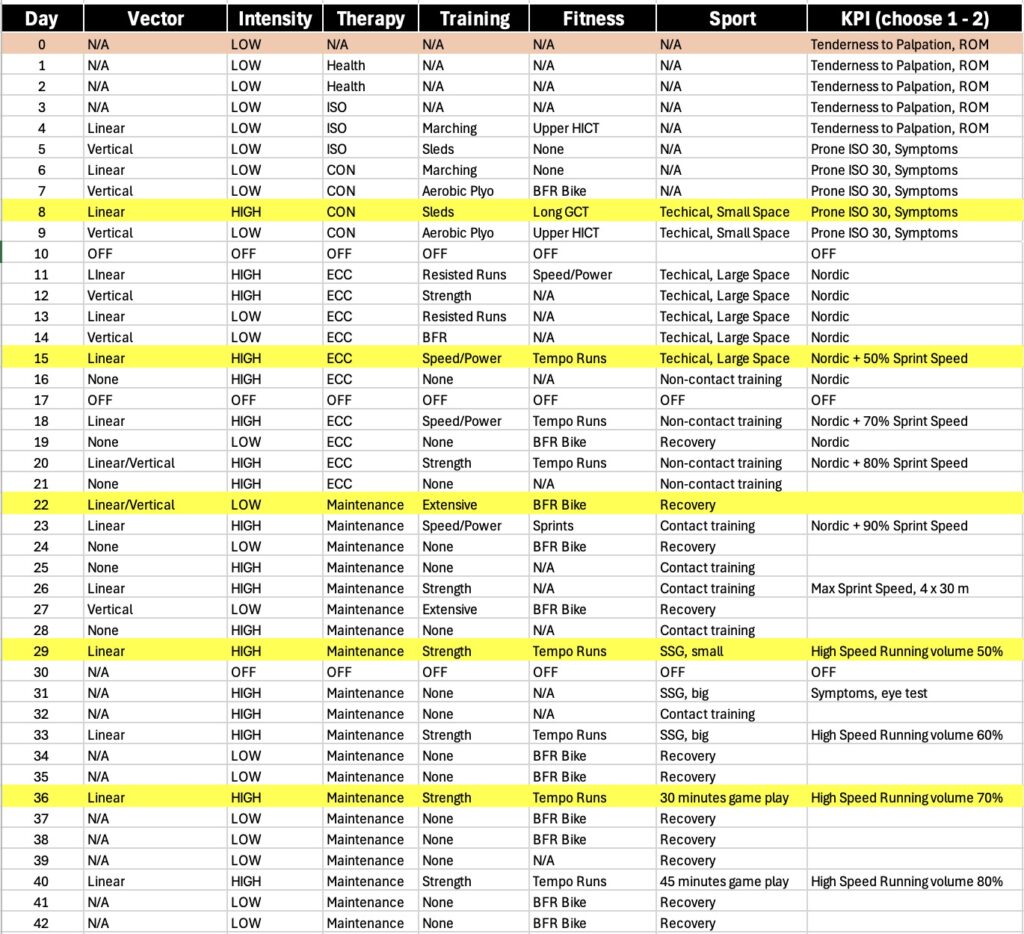
Check out this video as I share more details on the thought process of this plan, what certain language means, and underlying principles I set out to maintain.
Journal Assignment
Review a current client or athlete with a soft tissue injury. If not a current client, think back to a specific case you had within the last 12 months. Write out the rehab plan executing both the roadmapping and reverse engineering methods. Be sure to consider the following:
- The 10 Key Principles from the 3P Model (Week 1, Lesson 1)
- Biological healing timelines (Week 3, Lesson 3)
- Criteria for each phase of The Continuum
- Dynamic systems thinking (environment, task, and individual constraints)
- Primary vector(s) limited (Weeks 7, 8, & 9)
FAB FIVE
- Reverse Engineering for Precision: Start with the end goal—such as pain-free sprinting—and work backwards to define milestones like strength recovery and sport-specific readiness. Align each phase with biological healing timelines to ensure steady, goal-driven progress.
- Roadmapping for Flexibility: Develop multiple rehab routes to accommodate progress and setbacks. The primary route follows a linear progression, while alternate routes adjust for challenges like pain during eccentric exercises, shifting focus to isometric strengthening or neuromuscular training.
- Biological Timelines as a Compass: Respect the three phases of healing—inflammatory (0-7 days) for pain control, proliferative (7-21 days) for structural rebuilding, and remodeling (21+ days) for advanced strength and sport-specific drills—to anchor plans in physiological realities.
- Tracking Metrics for Adaptability: Monitor KPIs like hamstring-to-quadriceps strength ratio, pain-free running progressions, and neuromuscular control to guide decisions on progressing or regressing the plan and ensuring readiness for the next phase.
- Complementary Strategies for Success: Combine reverse engineering to provide structure and roadmapping to adapt dynamically, ensuring athletes meet their goals while minimizing reinjury risks and maintaining forward momentum.
SUPPLEMENTAL RESOURCES
BOOK: Checklist Manifesto by Atul Gawande highlights how simple checklists improve outcomes across industries by managing complexity, enhancing teamwork, and reducing errors, fostering reliability in high-stakes environments.