Welcome back to the 3P Injury Prevention Toolkit! In the first tool of the 3P Toolkit we discussed Movement. Today, we’re diving into the second essential tool: Strength.
Strength is far more than lifting heavy weights—it’s a critical, modifiable factor for injury prevention, longevity, and performance. Whether you’re looking to optimize your game, recovering from an injury, or striving for long-term health, strength training serves as a cornerstone for success. Let’s explore why.
Strength: a Foundation for Resiliency & Longevity
Strength isn’t just about performance—it’s about protecting your body. Research shows that:
- Relative strength is directly linked to lower extremity injury risk. For example, athletes with weaker lower body strength (relative to their body weight) are more likely to suffer injuries. A study by Case et al. (2020) found that male athletes with a squat strength below 2.2x their body weight and female athletes below 1.6x were at significantly greater risk for injury.
- Grip strength is a powerful predictor of overall health and longevity. Data from the UK Biobank reveals that weaker grip strength correlates with higher rates of cardiovascular disease, respiratory illness, and even cancer. Greater grip strength alone is not protective, but it is a proxy measure for people who regularly participate in exercise because they are constantly holding, pulling, and pushing objects.
- Lean muscle mass acts as a buffer against injuries and supports long term health. More muscle mass is strongly correlated to overall strength. Additionally, Dr. Gabrielle Lyon’s muscle-centric philosophy emphasizes the critical role of skeletal muscle in endocrine function and metabolism, positioning it as a central organ for regulating hormonal health, optimizing metabolic processes, and supporting longevity and disease prevention.
Whether your goal is to improve performance or optimize longevity, these findings emphasize the importance of strength as a tool for protecting your body from injury and disease.
The Science of Strength: adaptation & Recovery
Strength training works by applying stress to your body, triggering adaptation and growth. Here’s how it happens:
- General Adaptations
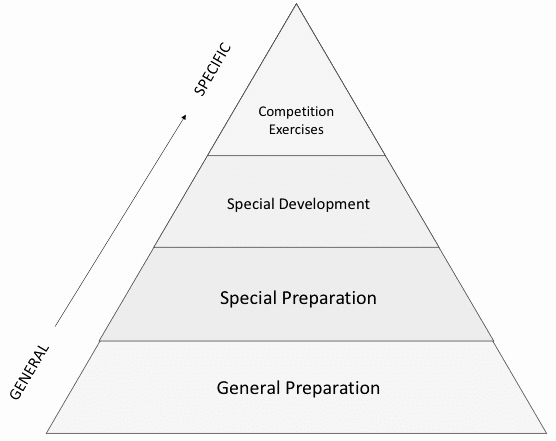
Strength training builds broad, foundational changes in your body, such as improved muscle fiber recruitment, tissue hypertrophy, and bone density. These adaptations create a base for athletic performance and injury prevention. - Activity-Specific Adaptations
Once a general base is built, training can become more specialized. This is where the principle of specificity comes into play: the body adapts to the type of stress it encounters. For example:- Basketball players focus on plyometrics to enhance explosive jumping.
- Wrestlers prioritize isometric strength to maintain holds.
- Runners incorporate eccentric training to improve deceleration.
- The Goldilocks Principle
Finding the right balance of stress and recovery is essential. Too little stimulus leads to stagnation, while too much stress increases the risk of overtraining and injury. Programs designed with the right intensity, volume, and frequency help people build strength safely and effectively.

Target both Local and Systemic Levels
Strength training impacts both local muscle adaptations and systemic changes, making it a comprehensive tool for enhancing performance and reducing injury risk. By addressing both peripheral and central adaptations, you can build a body that is stronger, more efficient, and better equipped to handle physical demands.
- Peripheral Adaptations:
Strength training induces changes at the muscular level, such as increased fiber recruitment, increased cross sectional area, and improved tensile strength of connective tissue. These local changes improve muscle performance and reduce injury risk.- Example: Nordic hamstring curls are excellent for building eccentric strength, reducing the risk of sprint-related hamstring injuries.
- Central Adaptations:
Systemic adaptations, like improved cardiovascular efficiency and enhanced neuromuscular coordination, allow your body to better support intense efforts. Strength training boosts stroke volume (the amount of blood your heart pumps per beat) and optimizes motor unit recruitment, improving overall performance.- Example: Sprint drills combined with heavy resistance training improve the central nervous system’s ability to coordinate rapid, explosive movements.
By targeting both peripheral and central adaptations, you can create a balanced, resilient body prepared to handle the demands of sport and daily life.


Muscle Hypertrophy & Injury Prevention
Hypertrophy is the process of increasing muscle size through resistance training, and it plays a significant role in injury prevention. When training for hypertrophy, there are two types of stress we can apply to muscles:
- Mechanical Stress: Heavy, low-rep training creates microtears in muscle fibers, promoting hypertrophy. Compound exercises like squats and deadlifts excel in applying mechanical stress.
- Metabolic Stress: High-rep, low-rest training builds the “pump” by accumulating metabolites, leading to hypertrophy. Blood flow restriction training is a great tool to maximize this effect.
Lastly, to maximize every rep for hypertrophy we must utilize full range of motion exercises in order engage more muscle fibers and optimize growth. For instance, deep squats recruit more fibers and enhance mobility compared to partial squats.
Build Strength with Different muscle Contraction Types
Understanding and utilizing different types of muscle contractions is essential for developing strength, stability, and resilience in both performance and rehabilitation. Each contraction type serves a specific purpose, offering unique benefits when incorporated into a training program.
- Isometric Contractions
Isometric contractions occur when a muscle generates force without changing its length. These are particularly useful for building stability, endurance, or in the early stages of a strength training or rehab program.- Example: Goblet squat holds are effective for improving knee stability, while overcoming isometrics (e.g., pushing against an immovable object) develop maximal force in specific joint angles.

- Concentric Contractions
In concentric contractions, muscles shorten as they generate force. This is the most familiar type of contraction, commonly seen during the lifting phase of movements.- Example: Lifting a dumbbell during a bicep curl demonstrates concentric contraction, essential for producing force and accelerating loads.
- Eccentric Contractions
Eccentric contractions involve muscles lengthening under tension, typically controlling the descent of a weight or decelerating the body. These contractions generate more force than concentric movements and are particularly valuable for injury prevention and rehabilitation.- Example: Slow eccentric hamstring curls are frequently prescribed to strengthen muscles during deceleration, reducing sprinting-related injuries.
By combining isometric, concentric, and eccentric contractions within a training program, athletes and individuals can create a well-rounded approach to strength development. This integration not only enhances performance but also safeguards against injuries, promoting long-term resilience and function.
Functional Training vs. Exercise Machines


Functional training emphasizes multi-joint, activity-specific movements that enhance coordination and balance. These exercises are designed to mimic real-world or athletic actions, improving both performance and movement efficiency. For example, rotational medicine ball throws replicate the mechanics of a pickleball serve, building power and core stability essential for dynamic movements.
On the other hand, exercise machines, though often undervalued, play a critical role in isolating muscle groups and addressing specific weaknesses. Machines reduce the learning curve of the exercise and allow individuals of all training background to participate in exercise. If hypertrophy of a specific muscle is the goal, machines are far superior to free weights. Furthermore, machines are a safe and effective way to introduce strength training for someone who is rehabbing an injury.
To optimize strength training, a blend of functional and machine-based exercises is essential. This approach ensures comprehensive strength development while supporting sport-specific carryover and injury prevention. For instance, a basketball player might incorporate functional cable lifts to improve core stability and rotational strength while using a leg press machine to safely develop quadriceps power. By combining these methods, athletes and individuals alike can achieve a well-rounded program that enhances both performance and recovery.
How to Improve Strength
Strength training isn’t one-size-fits-all. It requires thoughtful design to address individual needs and goals.
- Build Relative Strength:
Focus on specific benchmarks to reduce injury risk. Incorporate exercises like squats, deadlifts, and farmer’s carries to build resilience. Here are a few standards that are expressed as a percentage of bodyweight that you can aim for
| Exercise | Men | Women |
| Squat or Deadlift | 2.0x for 3-5 reps | 1.5x for 3-5 reps |
| Bench Press | 1.0x for 3-5 reps | 0.75x for 3-5 reps |
| Farmer’s Carry | 1.0x for 60 seconds | 0.75x for 60 seconds |
For example, if you are a 150-pound man then your squat strength goal is 300 pounds (2 x 150 = 300). If you are a 130-pound female, then your squat strength goal is 195 pounds (1.5 x 130 = 195).
- Integrate General and Specific Training:
General strength builds a foundation; activity-specific exercises fine-tune function. 80% of your exercise program should focus on simple, compound lifts such as squats, deadlifts, carries, or push-ups to build general strength. Then supplement the compound lifts with activity specific exercises. For example, a soccer player can use resisted sprints to mimic on-field acceleration demands or a parent can perform kettlebell get-ups to mimic playing with their kids on the ground.


- Balance the Stress with Recovery
Growth happens during the recovery. Whether the goal is enhancing maximal strength or promoting hypertrophy, adequate rest is necessary to achieve adaptions. If you are 30 years or younger, allow a 48-hour rest period between high intensity training sessions of specific muscles. If you are 30 years or older, increase that rest period to 72-hours. - Don’t Forget your Brakes
Did you know that we are approximately 20-30% stronger eccentrically than we are concentrically? Or that most hamstring injuries occur during the deceleration phase? Much of what we do in our exercise programs focus on concentric movements that improve our gas pedal. Don’t forget to include eccentric movements to improve your brakes and reduce injury risk.
Why Strength Matters?
Strength is more than just a physical trait—it’s a protective mechanism, a performance enhancer, and a predictor of long-term health. By incorporating strength training into your routine, you’re not just building stronger muscles—you’re creating a more resilient, capable version of yourself.
Stay tuned for the next tool in the 3P Injury Prevention Toolkit, where we’ll explore how FITNESS can take your performance and injury prevention to the next level. And if you have not done so already, be sure to check out the previous articles on the other tools of the 3P Toolkit – 3P Intro and Movement!
Sincerely,
Dr. Adam Loiacono
P.S. Want to dive deeper into the science of strength? Check out my article What Is Strength and Why Is It Important? for more insights.

Finding Small Wins Podcast!
Curious to learn how an Olympic sprint coach utilizes strength training for elite athletes?
Check out Episode 036 of the Finding Small Wins podcast to learn more!
- Celis-Morales CA, Welsh P, Lyall DM, et al. Associations of grip strength with cardiovascular, respiratory, and cancer outcomes and all-cause mortality: Prospective cohort study of half a million UK Biobank participants. BMJ. 2018;361:k1651. doi:10.1136/bmj.k1651
- Case MJ, Knudson DV, Downey DL. Barbell squat relative strength as an identifier for lower extremity injury in collegiate athletes. J Strength Cond Res. 2020;34(5):1249-1253. doi:10.1519/JSC.0000000000003511
- Gabbett TJ, Oetter E. From tissue to system: What constitutes an appropriate response to loading? Sports Med. 2024. doi:10.1007/s40279-024-02126-w